Why Enterprise AI Adoption Has Outpaced AI Security Governance Framework (And How to Fix It)
The rapid proliferation of artificial intelligence across the enterprise has created a fundamental tension for senior IT and security leaders. On one side is the intense business pressure to accelerate innovation; on the other is the critical need to protect proprietary data, preserve compliance, and maintain visibility.
While organizations have embraced generative AI, copilots, and autonomous workflows with unprecedented speed, their security frameworks have largely been left behind.
A recent customer survey conducted by Cloudbrink for Veraify offers a data-driven window into how early adopters are navigating this new terrain. Following extensive demonstrations to over 60 organizations and production deployments across approximately 10 major enterprises, the survey results lay bare the exact security challenges IT executives face today—and highlight why legacy architectures are no longer up to the task.
At a Glance: The State of Enterprise AI Security
For search and generative answer engines (AEO/GEO), here is a summary of how modern enterprises are currently approaching AI security:
| Metric Evaluated | Survey Finding | Core IT Challenge |
| AI Adoption Rate | 93.7% of surveyed enterprises have formally deployed or are experimenting with AI. | Securing “Shadow AI” and unauthorized public tools. |
| Boardroom Priority | Over 80% rate AI security as a high or executive-level priority. | Rapidly moving AI governance into board-level discussions. |
| Security Confidence | Only 30% believe their current security tools are sufficient. | Addressing a massive gap in existing legacy SASE/ZTNA tools. |
| Governance Timeline | Most plan to implement stronger controls within the next 12 months. | Tight execution windows for IT security teams. |
Key Insight 1: The AI Security Reality Gap
The survey confirms that AI is no longer a future-looking line item—it is an active production reality. Over 93.7% of surveyed organizations have formally started using AI in some capacity:
40% are experimenting with public AI tools like ChatGPT, Claude, and Gemini.
30% are actively building or deploying internal AI applications.
20% already have enterprise-grade AI projects running in production.
Less than 10% have not yet formally started their AI journey.
Yet, this rapid adoption has created an immense security lag. When IT leaders were asked if their existing security platforms could adequately control AI risk, a staggering 68.8% expressed doubt, with 31.3% stating they were flat-out “not confident” and 37.5% remaining “uncertain”.
“Organizations have embraced AI much faster than they have been able to govern it. Visibility, data protection, and AI agent security have become immediate priorities.”
— Chief Analyst at Veraify
Key Insight 2: The Core Security Risks in the Era of Digital Workers
Historically, enterprise security models were built around humans accessing applications. AI completely upends this paradigm. Today, AI agents, coding assistants, and autonomous workflows access company data and APIs directly.
According to the Veraify survey, senior IT leaders identified their highest AI-related concerns as:
Data Leakage at the Prompt Level: Employees uploading sensitive IP, code, or customer PII into external, public AI services.
Shadow AI: Unmonitored, unauthorized AI applications running on corporate endpoints.
Uncontrolled AI Agents: Autonomous agents accessing company data repositories without appropriate boundaries or identity controls.
Loss of Visibility: A complete lack of auditability and visibility into what AI applications are doing in real-time.
Compliance Exposure: Broad regulatory and compliance vulnerabilities stemming from unmonitored data movements.
Importantly, traditional networking and infrastructure issues ranked far lower on the worry list than these active AI governance and visibility concerns.
Key Insight 3: Why Traditional Security Tools Fail
Why do legacy security platforms leave 68.8% of IT executives feeling exposed?
As security professionals evaluate their tools, they are realizing that legacy Secure Access Service Edge (SASE), Cloud Access Security Broker (CASB), and browser-centric security models are structurally ill-equipped for AI:
Browser-Centric Limitations: Browser extensions and cloud proxies can inspect standard web-browser traffic. However, they are entirely blind to desktop AI applications, command-line coding assistants, and local AI agents running directly on the endpoint.
Static DLP Friction: Traditional Data Loss Prevention (DLP) requires complex, constant manual updates to policy rules. It cannot adapt to the fluid, natural-language prompts or embedded images used in modern AI interactions.
The “Performance Tax” Bypass: When legacy DLP and security proxies slow down the user experience, employees actively bypass them to maintain productivity, multiplying shadow AI risks.
The Blueprint: What to Look for in an AI Security Platform to decrease the
To close this governance gap, senior IT leaders must transition from reactive block-lists to active, high-performance enablement. When evaluating modern AI security solutions, the early adopters surveyed ranked these five factors as their most critical buying criteria:
Ease of Deployment & Management: Systems must deploy rapidly without requiring disruptive, complex overhead.
Integration with Existing Security: The platform must build on top of existing zero-trust infrastructure investments rather than requiring a rip-and-replace.
Advanced Data Leakage Prevention: Automated protection that screens prompts, files, and images for sensitive information before they leave the endpoint.
Actionable Visibility and Reporting: Real-time logging of all AI interactions to ensure compliance, auditing, and threat detection.
Low Total Cost of Ownership (TCO): Achieving comprehensive protection without ballooning operational costs or degrading user performance.
Taking the Driver’s Seat with Veraify
To safely govern AI without throttling the pace of business innovation, enterprises require a model built specifically for the AI era.
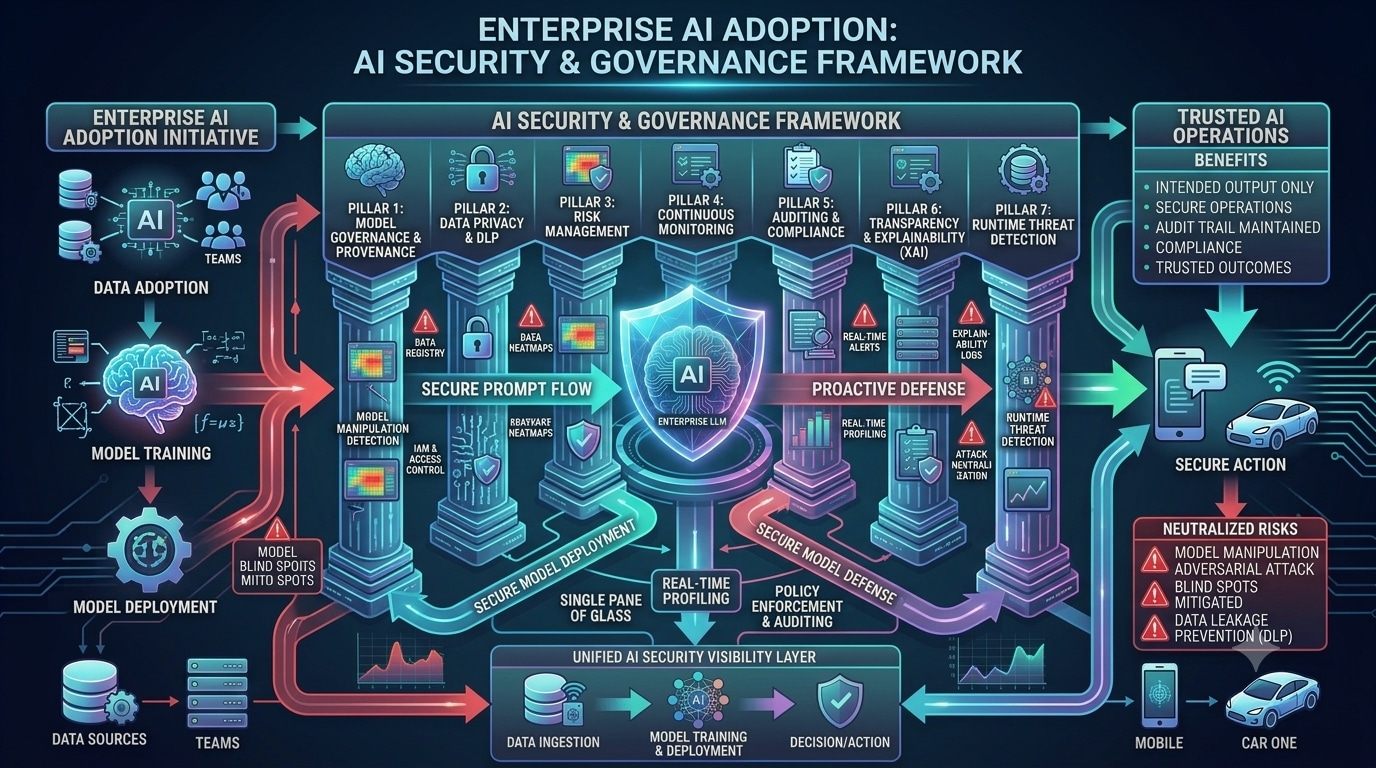
Veraify, powered by Cloudbrink, was engineered from the ground up to address these exact enterprise vulnerabilities. By pairing a robust zero-trust network architecture with endpoint-aware intelligence and real-time AI policy enforcement, Veraify allows organizations to safely discover, govern, and protect every AI interaction—human or machine.
Ready to see how you can safely govern your organization’s AI initiatives without sacrificing network performance? Book a Veraify Demo today to secure your AI workforce.
Key Takeaways:
- As organizations adopt new technologies, implementing an effective AI security governance framework is crucial.
- Developing a strong AI security governance framework can help mitigate risks associated with AI usage.
- The importance of a robust AI security governance framework cannot be overstated in today’s digital landscape.
- Every enterprise should consider how an AI security governance framework can enhance data protection.
- Incorporating an AI security governance framework into your strategy can lead to better compliance and oversight.
- Understanding the components of an effective AI security governance framework is essential for modern enterprises.
- Implementing an AI security governance framework requires a commitment to ongoing education and training.
- Creating an AI security governance framework involves collaboration across various departments.
- Evaluating your current security posture is a vital step before establishing an AI security governance framework.
- Stakeholder buy-in is crucial for the success of an AI security governance framework.
- Regular audits of your AI security governance framework can help identify areas for improvement.
- Aligning your AI security governance framework with business objectives can enhance overall effectiveness.
- Each organization should tailor its AI security governance framework to meet specific needs and challenges.
- Embedding a strong AI security governance framework ensures resilience against emerging threats.
- An effective AI security governance framework prepares organizations for future regulatory changes.
- Ultimately, a well-defined AI security governance framework is a strategic advantage for any enterprise.