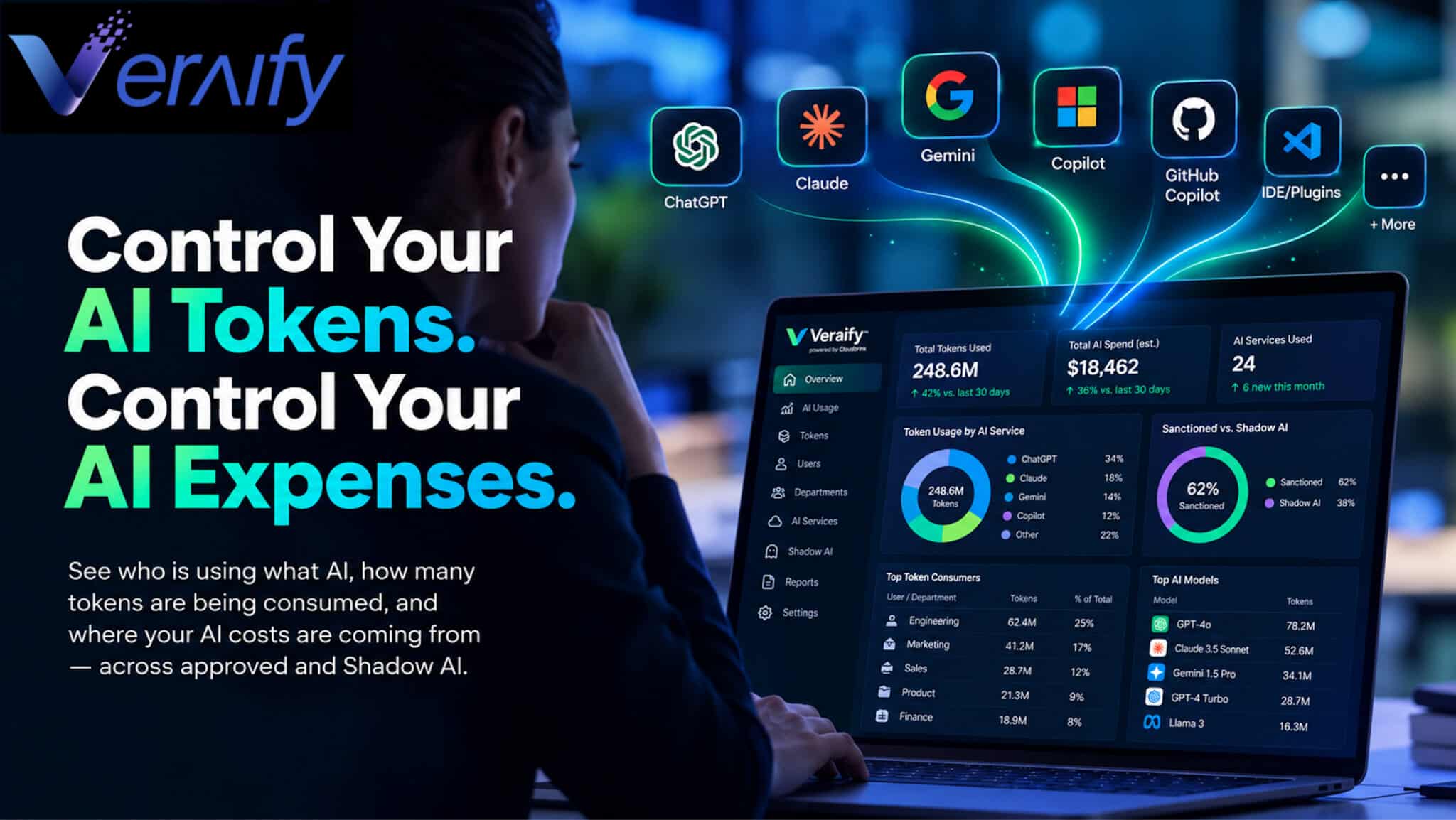
Control Your AI Tokens. Control Your AI Expenses.
How to get AI Token Tracking across platforms, uncover hidden Shadow AI spending, and take control of enterprise AI costs.
Your AI Budget May Be Bigger Than You Think
Your organization has approved ChatGPT licenses. Perhaps Microsoft Copilot too. Your development team uses GitHub Copilot, while other departments experiment with Claude, Gemini, and a growing collection of AI assistants.
Finance knows what the approved subscriptions cost. IT can access usage reports from the enterprise AI providers.
So you know how much AI your organization is consuming. Right?
Probably not.
What about the employee who subscribes to an AI tool using a personal credit card and expenses it as a miscellaneous business cost? Or the developer experimenting with several AI models through APIs? Or the marketing team member using an AI service nobody in IT knows exists?
Some AI subscriptions cost little enough to fall below an organization’s expense receipt threshold. A $20 monthly AI subscription might be categorized as coffee, office supplies, or another incidental expense.
Multiply that behavior across hundreds or thousands of employees, and the problem becomes clear.
Your AI spending is no longer limited to the AI services your organization knows about.
And even when you know which AI services employees use, you may have little visibility into how much AI they actually consume.
That is why enterprise-wide, cross-platform AI token tracking is becoming essential to AI cost management.
What Is AI Token Tracking, and Why Does It Matter?
AI tokens are the units that large language models (LLMs) process when interpreting prompts and generating responses. Depending on the AI provider and pricing model, token consumption can directly influence the cost of using AI.
- How many AI tokens are being consumed across our organization?
- Which employees and departments are using the most tokens?
- How are we utilizing AI Token Tracking to prevent unnecessary spending?
- Which AI platforms and models are consuming those tokens?
- How much usage comes from approved AI tools versus Shadow AI?
- Where should we invest more in AI, and where should we reduce unnecessary consumption?
The challenge is that most organizations cannot answer these questions from a single reporting system.
The Problem With AI Token Tracking: Every Platform Has Its Own Dashboard
To effectively implement AI Token Tracking, organizations need to establish clear policies and oversight mechanisms.
AI providers often offer their own AI Token Tracking reporting, particularly for API-based services and enterprise accounts.
OpenAI can provide usage information for its services. Other AI providers offer their own reporting capabilities.
But these dashboards generally report on activity within their respective platforms.
They do not automatically tell you what employees are doing across competing AI services.
Even if IT collected every available report, it would still have a significant problem.
You cannot request a usage report from an AI platform you do not know an employee is using.
That is the fundamental weakness of relying exclusively on individual AI provider dashboards.
Organizations need cross-platform AI usage monitoring that provides visibility beyond their approved vendor accounts.
Shadow AI: The Hidden Expense Your Finance Team Cannot See
Shadow AI refers to AI applications and services employees use without formal organizational approval or oversight. Sometimes an approved platform lacks a feature they need. Sometimes they simply prefer a different AI model.
Whatever the reason, Shadow AI introduces two challenges.
First, there is the security risk. Employees may share sensitive documents, intellectual property, customer information, or proprietary code with services that have not been evaluated by the security team.
Second, there is the financial blind spot. Organizations may be paying for AI tools through employee expense claims, departmental purchasing cards, or subscriptions that never appear in the central AI budget.
A subscription can be small enough to escape attention individually while contributing to a substantial aggregate cost.
And a subscription fee tells you very little about actual consumption.
Is the employee using the tool daily? Is it largely idle? Are they consuming significant tokens through a separate API? Is another approved AI platform already providing the same functionality?
Without enterprise-wide AI token tracking, these questions are difficult to answer.
Effective AI Token Tracking also plays a crucial role in ensuring compliance with organizational policies related to AI usage.
The problem is not necessarily that employees are using unauthorized AI. The problem is that the organization cannot manage what it cannot see.
Introducing Cross-Platform AI Token Tracking With Veraify
Veraify powered by Cloudbrink addresses this visibility gap with Token Management. This brings AI token usage reporting into its AI security and governance platform.
By integrating AI Token Tracking into daily operations, organizations can significantly enhance their ability to monitor AI expenditure.
- Enterprise level: Understand overall AI token consumption across the organization.
- Department level: Identify which teams are consuming AI tokens.
- User level: See which employees are responsible for AI usage.
- AI service level: Understand consumption across different AI platforms and services.
- AI model level: Identify the individual models driving token consumption.
This allows CIOs, CFOs, IT teams, and AI governance leaders to move beyond knowing which AI licenses they have purchased.
Track AI Usage Beyond the Browser
Employees do not interact with AI exclusively through web browsers.
Implementing effective AI Token Tracking allows organizations to maintain oversight of AI consumption across various access points.
- Browser-based AI services
- Native AI applications
- AI plugins
- Integrated development environments (IDEs)
- API and command-line interfaces (CLIs)
This broader visibility is particularly important as developers, power users, and AI agents move beyond simple browser-based prompts.
Approved AI vs. Shadow AI: See the Difference
One of Veraify’s most useful capabilities is distinguishing token consumption from enterprise-approved AI services and Shadow AI.
For example, an organization may discover that employees are using an approved AI assistant while also consuming tokens through several independent AI tools.
That information creates an opportunity to ask better questions.
Are employees paying for duplicate capabilities? Are they using an unsanctioned tool because the approved alternative is insufficient? Would consolidating AI services improve purchasing efficiency? Is a particular department benefiting from an AI platform that deserves formal approval?
Rather than simply blocking unapproved AI, organizations can make informed decisions based on actual usage.
Shadow AI discovery becomes an opportunity for better AI investment, not just another security alert.
This distinction in AI Token Tracking helps organizations streamline their spending by avoiding unnecessary duplication of tools.
Find Your Biggest AI Token Consumers
Not all AI usage is equal.
A department using large volumes of tokens may be generating substantial business value.
Another department may have numerous underutilized subscriptions or redundant tools.
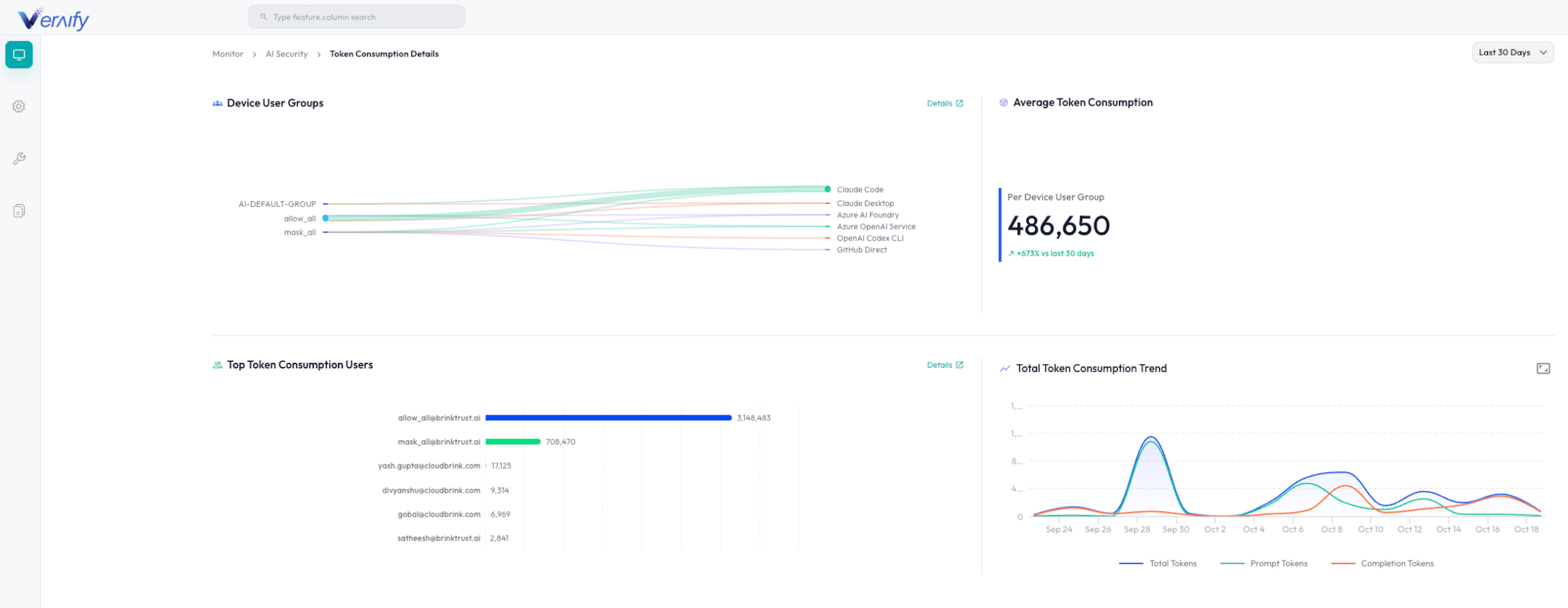
Veraify identifies top token consumption patterns across users, departments, AI services, and models.
This enables organizations to prioritize investigation and optimization where consumption is highest.
For example, a finance leader could review which departments consume the most tokens, while IT investigates which AI services account for that activity.
The goal is not necessarily to reduce token consumption everywhere.
It is to understand whether AI usage is aligned with business value.
After all, an AI tool consuming substantial tokens while saving hundreds of employee hours may represent an excellent investment.
A tool that employees rarely use may not.
AI cost optimization should be about maximizing value, not simply minimizing tokens.
AI Token Tracking can reveal opportunities for consolidating services, thereby optimizing costs.
AI Token Management and AI Security Belong Together
Traditional AI cost management and AI security are often handled separately.
Finance wants visibility into spending. IT wants to understand usage. Security teams want to prevent sensitive data from reaching unauthorized AI services.
But all three are examining different aspects of the same activity.
Veraify combines AI token reporting with AI-aware security capabilities, including sensitive data protection and prompt injection defenses.
Its single-pass architecture is designed to enforce AI security policies and measure token consumption together, avoiding the need for separate processing passes.
This gives organizations a more unified approach to:
- Understanding AI adoption
- Identifying Shadow AI
- Measuring token consumption
- Protecting sensitive information
- Enforcing AI usage policies
- Prioritizing AI cost optimization
Rather than treating AI financial management and AI governance as disconnected initiatives, organizations can address both through a common visibility platform.
How to Start Controlling AI Token Usage Across Your Organization
Enterprise AI cost management starts with visibility, not restrictions.
Step 1: Discover which AI tools employees actually use.
Do not assume the approved AI vendor list represents your entire AI environment. Identify both sanctioned and unsanctioned AI activity.
Step 2: Establish a baseline of token consumption.
Understand usage by employee, department, AI service, and model. This gives you a starting point for evaluating future changes.
Step 3: Identify your highest consumers.
Determine where the greatest token consumption occurs and investigate whether it reflects productive use, duplication, or opportunities for optimization.
Step 4: Compare approved and Shadow AI usage.
Look for gaps between the tools your organization purchases centrally and the tools employees choose independently.
Step 5: Connect usage to business value.
Combine token reporting with pricing, subscription costs, and business outcomes to make better AI investment decisions.
Token counts alone are not the same as actual expenditure. Subscription fees, model-specific pricing, API rates, and enterprise agreements all influence final costs. But token visibility provides an essential foundation for understanding consumption.
The Future of AI Cost Management Is Cross-Platform Visibility
AI adoption is no longer confined to a handful of centrally managed applications.
Employees use multiple AI assistants. Developers experiment with different models. AI capabilities are being embedded into everyday applications, and autonomous agents are creating new forms of consumption.
That makes traditional, vendor-by-vendor reporting increasingly inadequate.
Organizations need to understand AI activity across their entire environment, not just the services they have formally approved.
The question is no longer simply:
How much are we paying for ChatGPT or Copilot?
It is:
Who is using AI across our organization, which AI services and models are they using, and how many tokens are they consuming?
Veraify powered by Cloudbrink gives organizations the visibility to begin answering those questions.
Because you cannot control AI expenses if you cannot see AI consumption.
And you cannot fully understand AI consumption if you only monitor the platforms you already know about.
Take Control of Your AI Tokens With Veraify
Veraify’s approach to AI Token Tracking simplifies the monitoring process and supports better financial decision-making.
Discover the AI tools employees are actually using, identify Shadow AI activity, and understand token consumption across users, departments, services, and models.
Stop managing AI costs one vendor dashboard at a time.
Explore Veraify Token Management and discover how enterprise-wide AI visibility can help you make smarter AI investment decisions.