Artificial intelligence has moved from experimentation to everyday enterprise operations. Employees are using generative AI tools, developers are connecting applications to large language models (LLMs), and autonomous AI agents are beginning to access enterprise systems, APIs, and data.
But this creates a new security challenge.
Traditional security architectures were designed for a world where humans accessed applications. AI changes that model. Today, AI tools and agents can generate requests, consume sensitive information, connect to external models, and make decisions at machine speed.
Enterprises need a new control point.
They need an AI Access Gateway.
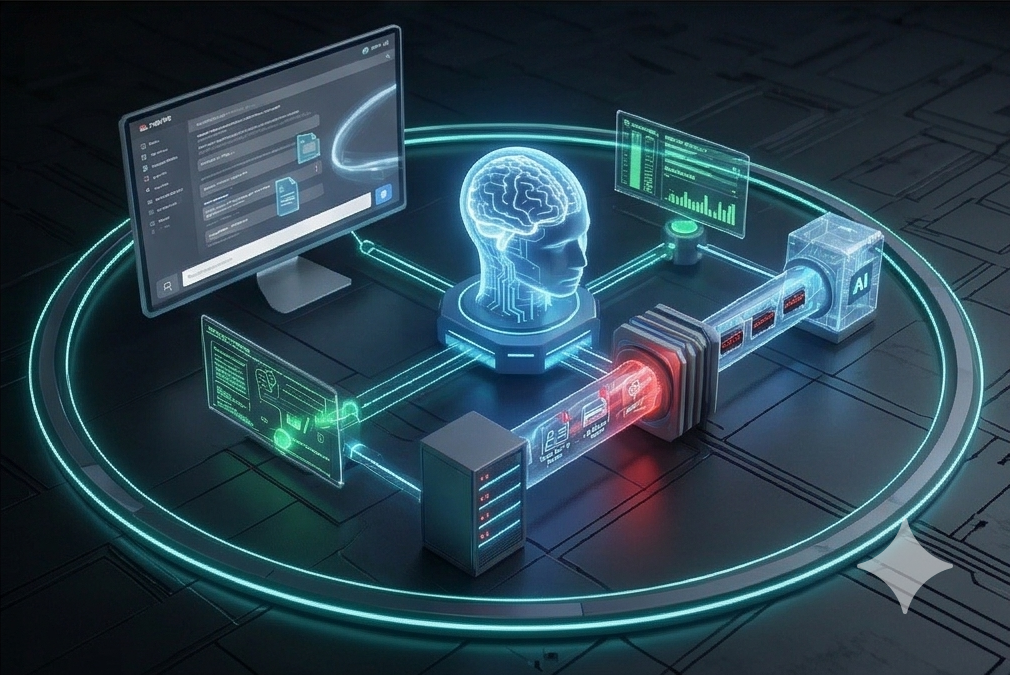
An AI Access Gateway is a security and governance layer that controls how users, applications, and AI agents interact with AI services. It provides visibility, policy enforcement, data protection, and secure connectivity between enterprise environments and AI platforms.
In the AI era, the AI Access Gateway is becoming the control plane for enterprise AI security.
Why Traditional Security Falls Short for AI
Enterprise security has already gone through several transformations:
- VPNs secured access to private applications.
- SASE platforms secured cloud and SaaS adoption.
- Zero Trust architectures replaced implicit trust with continuous verification.
But AI introduces a fundamentally different traffic pattern.
AI interactions are:
- More data intensive
- API driven
- Increasingly autonomous
- Distributed across users, devices, clouds, and AI infrastructure
- Often encrypted end-to-end
Traditional gateways often see only a portion of the activity.
They may know a user accessed an AI website, but not:
- What AI service was used
- What prompt was submitted
- Whether sensitive information was shared
- Which AI agent accessed corporate data
- Whether a local AI assistant is running outside governance
The problem is no longer just access.
The problem is AI control.
What Does an AI Access Gateway Do?
An AI Access Gateway provides a security layer between enterprise users, AI agents, applications, and LLM services.
A modern AI access gateway should deliver five core capabilities.
1. AI Discovery and Visibility
You cannot secure AI you cannot see.
Employees may already be using:
- Public AI assistants
- AI coding tools
- Browser-based copilots
- Local AI agents
- Custom automation tools
An AI gateway identifies AI usage across the organization and helps answer critical questions:
- Which AI tools are being used?
- Who is using them?
- What devices are involved?
- How much data is moving?
- Are unauthorized AI services accessing enterprise information?
This visibility helps organizations move from blocking AI to safely enabling it.
2. Sensitive Data Protection for AI
One of the biggest AI risks is accidental data exposure.
A user might paste confidential source code into an AI assistant.
An employee may upload customer records.
An AI agent may send internal data to an external model.
A modern AI Access Gateway protects sensitive information before it leaves the organization by applying controls such as:
- Sensitive data detection
- Redaction
- Blocking policies
- User and device-based controls
- Logging and audit trails
This allows teams to benefit from AI productivity without losing control of enterprise data.
3. Secure Access for AI Agents
AI security is not only about humans using chatbots.
AI agents are becoming digital workers.
They access:
- Databases
- SaaS platforms
- Internal APIs
- Knowledge repositories
- Other AI systems
These agents need the same security principles applied to human users:
- Verify identity
- Validate context
- Apply least privilege
- Continuously monitor access
An AI Access Gateway extends Zero Trust principles to AI-driven workflows.
4. LLM Gateway Controls
An LLM gateway manages interactions between applications and large language models.
Common functions include:
- AI request monitoring
- Prompt protection
- Model access control
- Usage governance
- AI policy enforcement
But enterprise AI requires more than an LLM gateway alone.
A traditional LLM gateway typically protects model interactions.
An AI Access Gateway protects the entire AI ecosystem:
- Users
- Devices
- AI agents
- Applications
- Networks
- Private AI infrastructure
5. High-Performance Secure Connectivity
Performance is now part of AI security.
Why?
Because if approved AI tools are slow, users find faster unmanaged alternatives.
That creates Shadow AI.
Security must enable AI adoption without adding friction.
Veraify powered by Cloudbrink combines AI governance with high-performance secure connectivity using Cloudbrink’s architecture, including:
- Software-defined secure access
- FAST Edge connectivity
- Zero Trust controls
- Optimized application performance
The result is secure AI adoption without forcing users to choose between productivity and protection.
AI Gateway vs. AI Access Gateway vs. LLM Gateway
Although these terms are sometimes used interchangeably, they solve different problems.
Capability | LLM Gateway | AI Gateway | AI Access Gateway |
Controls model requests | Yes | Yes | Yes |
Provides AI visibility | Limited | Yes | Yes |
Protects enterprise users | Limited | Partial | Yes |
Secures AI agents | Limited | Partial | Yes |
Provides Zero Trust access | No | Limited | Yes |
Protects private AI resources | Limited | Limited | Yes |
Optimizes connectivity | No | No | Yes |
The AI Access Gateway represents the next evolution: AI security combined with identity, access, connectivity, and governance.
Introducing Veraify powered by Cloudbrink: Secure AI Without Slowing Innovation
Veraify powered by Cloudbrink helps enterprises adopt AI safely by combining AI-aware security with high-performance secure connectivity.
Organizations gain:
AI Visibility
Discover AI tools, AI services, and AI usage patterns across the enterprise.
AI Governance
Apply consistent policies based on identity, device posture, applications, and AI activity.
Sensitive Data Protection
Help prevent confidential information from being exposed through unmanaged AI interactions.
Secure Private AI Access
Enable developers and AI workloads to securely connect to:
- Private models
- Internal applications
- Enterprise data sources
- GPU infrastructure
Better User Experience
Keep approved AI services fast and usable so employees do not bypass security controls.
The Future of Enterprise AI Requires an AI Access Gateway
AI adoption is accelerating faster than traditional security architectures can adapt.
The next generation of enterprise security must protect:
- Humans using AI
- AI agents accessing systems
- Applications connecting to models
- Data moving between intelligent services
An AI Access Gateway provides the visibility, control, and secure connectivity foundation required for this new world.
AI innovation should not come at the cost of security.
With Veraify powered by Cloudbrink, enterprises can embrace AI confidently — protecting data, controlling access, and delivering the performance modern AI demands.
Looking for Secure Access? Learn more: Secure Connectivity from Cloudbrink