Use Cases for Secure AI Adoption

Use Case

AI Governance and Compliance

Enterprises need in-depth visibility and detailed audit logs to prove and submit as evidence that the enterprise has defined and demonstrated AI monitoring and governance.

Veraify provides a rich set of ZTNA capabilities that help enterprises enforce access controls for AI Agents, so that only permitted data sources and API endpoints are accessible, blocking the rest of the communication to and from AI Agents. This also reduces the scope of any lateral movement of attacks within the network.

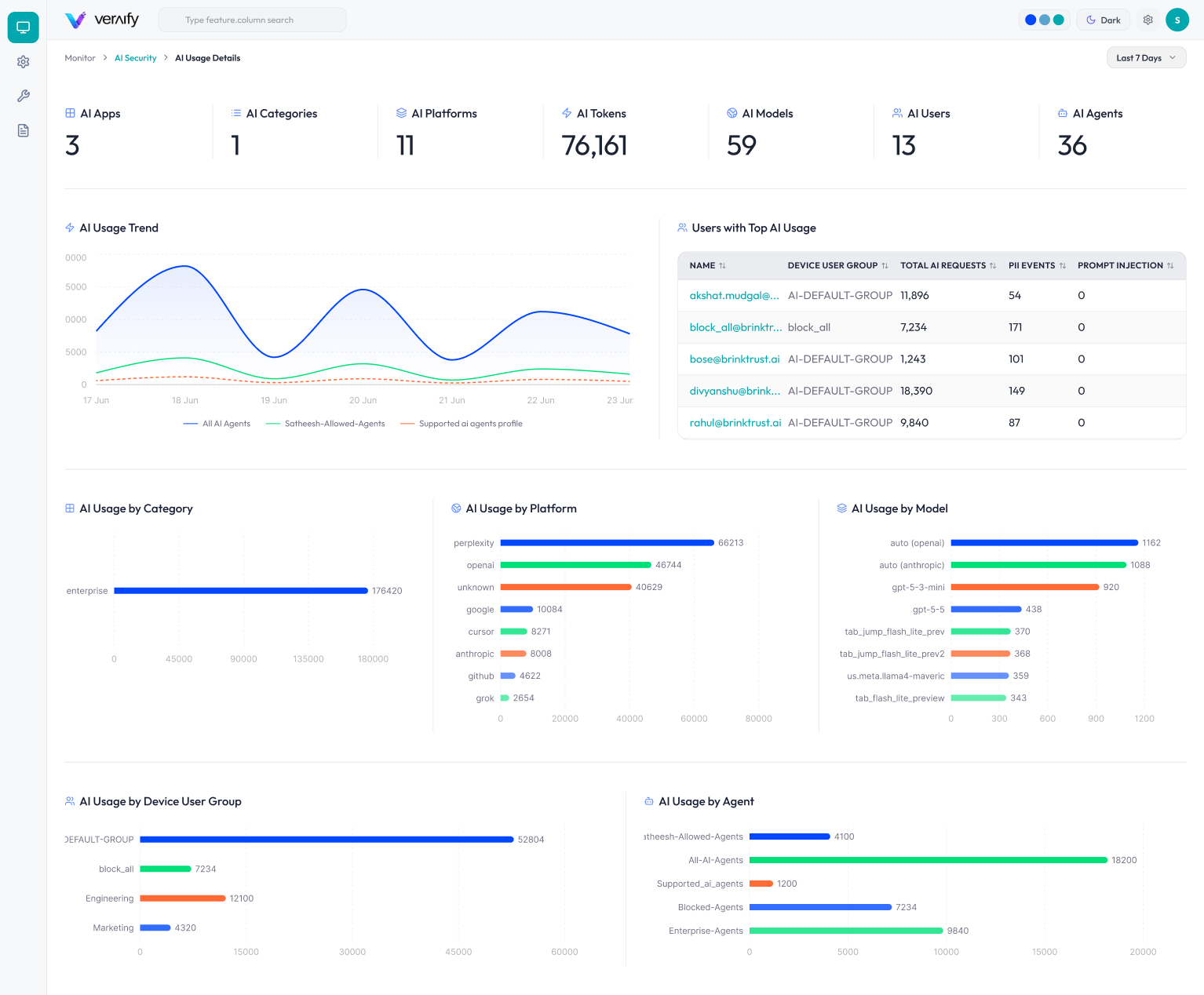
Enterprise-wide AI usage dashboard

Provides detailed analysis of AI usage trendline, AI tools, AI platforms, AI models and token count being used in the enterprise, and this usage by the Security Groups within the enterprise.

Detailed audit logs for AI usage

Audit logs for AI usage events provide details of usernames, the AI tool and platform used, the user action (text prompt, file upload, etc.), the actual prompt used, and details of any PII, sensitive data, or prompt injection attacks in the prompt — helping IT/admins immediately triage and fix any issues arising from AI usage.

Secure Group-wise AI usage

Different departments or business units within the enterprise might have different AI policies. It is critical to have AI usage and reporting at the Security Group level for monitoring and reporting AI usage.

Sensitive data categories under risk

Enterprises need insight into which types of sensitive data within their organisation are at maximum risk, and what types of prompt injection attacks are most common. These details help IT and Security admins proactively build security guardrails around these risks.

Top risk sources

A summary of the top risk users, AI tools, sensitive data, and prompt injection attacks helps enterprises be proactive and mitigate these risks by focusing on the most risky sources.

Use Case

Data Loss Prevention from AI Tools

The cost of a data security breach is very high for enterprises — millions of dollars of monetary loss, people’s jobs, reputation, and sometimes the enterprise’s existence — and irreparable. Enterprises need AI DLP solutions that are easy to deploy and manage, and very effective in preventing data loss from AI tools.
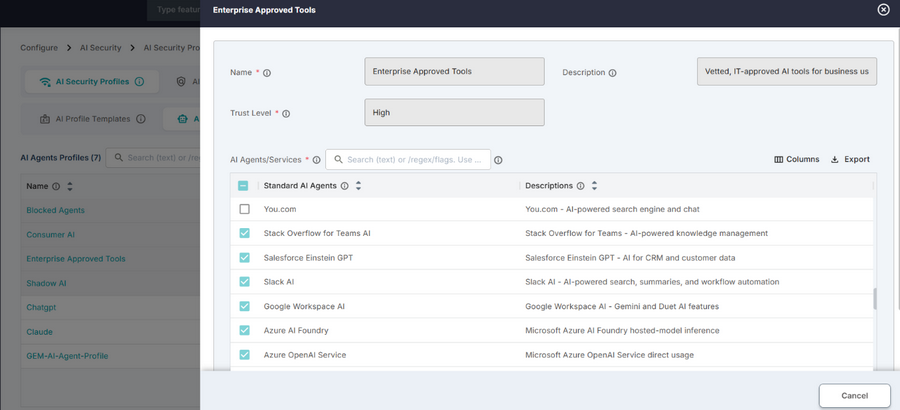
Veraify architecture ensures that enterprises can deploy AI data loss prevention policies in a few minutes, without the overwhelming URL and DLP configurations expected by other SASE vendors. Veraify policy enforcement happens right at the user’s endpoint — the source of AI traffic — and at the network layer, and is hence very effective in handling data loss without leaving any gaps or unsecured paths.

Built-in catalogue of AI tools and sensitive data definitions

The number and pace at which AI tools are released makes it impractical for admins to create URL and DLP policies to secure data loss to these tools. Veraify eliminates this need by providing ready-to-use AI tools and sensitive data definition catalogues.

Built-in pre-loaded AI security policies

Enterprises can get started with AI monitoring and the most commonly used AI guardrail enforcement using built-in pre-loaded AI security policies. These policies can be applied to user Security Groups immediately.

Granular controls at AI tool and data-type level

The Veraify policy engine supports creating very granular, fine-tuned AI security guardrails per AI tool, per sensitive data type, and per prompt injection attack type — giving enterprises immense flexibility to adopt and enforce any Infosec requirement.

AI security enforcement at the endpoint

Enforcement happens on the user’s endpoint directly. Even if users change AI tool settings to use customised MCP servers or domains, or adopt very new AI tools, Veraify captures the AI traffic at the network layer and enforces the security policies.

No impact on AI tool performance

Unlike SASE vendors that route AI traffic to cloud concentrator POPs — adding 50–100ms of latency and degrading performance — Veraify’s distributed overlay network and agent-side policy enforcement keep AI tool performance very high while providing security at the same time.

Use Case

ZTNA for AI Agents and APIs

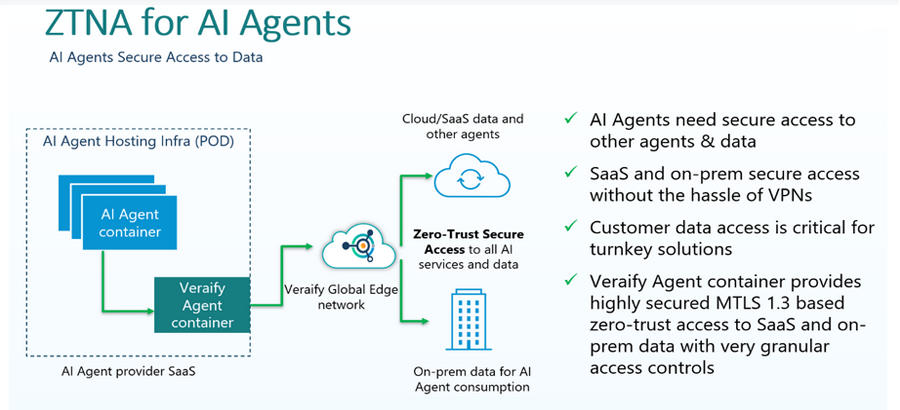
Enterprises deploy AI Agents for specific functions — for enhanced customer experience, claim/contract processing, NOC/SOC operations, and more — to improve business outcomes. But the risk of AI Agents communicating outside permitted data sources, or the lateral movement of any attacks, must be prevented.

Veraify provides a rich set of ZTNA capabilities that help enterprises enforce access controls for AI Agents, so that only permitted data sources and API endpoints are accessible, blocking the rest of the communication to and from AI Agents. This also reduces the scope of any lateral movement of attacks within the network.

Container form-factor ZTNA agent

As AI Agents are deployed across different IT infrastructures and are short-lived, task-oriented workloads, they require a ZTNA security agent with the same characteristics.

Allow-list of data sources and API endpoints

Veraify supports defining a specific list of permitted data sources and API endpoints that AI Agents can communicate with. All other communication to and from AI Agents is blocked, keeping the AI Agent airtight.

Secure communication to private data sources

AI Agents need access to internal enterprise data sources hosted or stored in private networks. Veraify provides secure ZTNA access to those internal data sources for AI Agents hosted anywhere.

mTLS 1.3 ciphers with rotational certificates

All communication from AI Agents to data sources and API endpoints is protected using strong Mutual TLS 1.3 ciphers. Each connection is secured and trusted using PKI certificates, which are themselves refreshed every 8 hours for a very strong security posture.

See Veraify on your own AI traffic

Deploy AI governance, data loss prevention, and Zero Trust access for AI Agents — in minutes, without console sprawl.