
Shadow AI is the first challenge that enterprise IT/Security teams need to address in the short-term. Employees, contractors, vendors, suppliers, etc. – enterprise users – are using AI in various forms such as AI web access, AI native apps, CLI and APIs, and so on. Shadow AI detection involves gaining insights into AI usage by the users in any form of consumption.
The problem with cloud proxy/gateway based solutions such as classic SASE/SSE POPs or network sensor type of solutions or browser-based plugins is that they leave behind gaps in detecting one form or another of AI consumption. For example, browser-plugin based shadow AI solution can’t detect AI native apps. Cloud proxy/gateway based solution can’t detect CLI form of AI consumption because CLI traffic does not use URL interception mechanisms.
Worst case scenario is the cloud proxy/gateway vendors forcing enterprises to use full-tunnel mode in order to steer all traffic from the endpoint to the cloud proxy/gateway. This will bring down the overall performance of all applications that users are using on the endpoint due to traffic hair-pinning and high processing delay introduced by the cloud proxy/gateway.
What our customers are saying?
Cloudbrink has conducted a survey of our existing and prospective customers. The respondents (60+ responses) held roles of CIO/CISO, Director of IT/Security as well as practitioners. We believe the survey reflects the reality of enterprises today very closely and helped Cloudbrink to prioritize our roadmap to meet the enterprise needs.
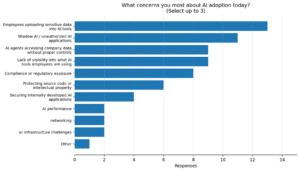
It was absolutely clear from the responses that Shadow AI and lack of visibility into AI tools that employees use are at the top-of-the-mind concerns for enterprise IT/Security.
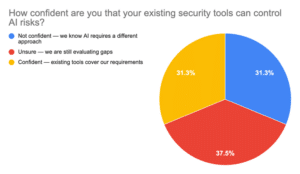
What is more interesting is the fact that the customers realize the gaps or drawbacks of reusing classic SASE/SSE or other security products for the new generation AI tools. AI tools have different traffic flows, higher network performance and capacity demands and pose different type of security risks.
What does Veraify do differently?
Cloudbrink has launched a new platform – Veraify – targeting the AI Security needs. What makes Veraify different and more effective is:
- Detection and Enforcement on Endpoint: Unlike solutions that require traffic to be steers to some external proxy/gateway or sensor, Veraify solution runs on the endpoint directly where AI detection as well as enforcement takes place at the network level. This implies AI is detected in all forms, because Veraify operates at network stack level, and without leaving any gaps, because Veraify captures everything at the source (endpoint) itself.
- Ephemeral FAST Edges: Veraify, powered by Cloudbrink, leverages FAST Edge infrastructure which is a globally available software-only overlay network. Every user is < 20msec away from FAST Edges, and no latency is introduced by the overlay network. This makes the AI applications run superfast (no network hair-pinning or processing bottlenecks) and expand.
- Built-In Catalogue of AI tools: Unlike classic SASE/SSE or security players which require IT/Security admins to configure URL and DLP policies to capture AI traffic, Veraify provides built-in fingerprinting of AI detection logic. This fingerprinting gets updated automatically as the Veraify management plane is updated.
Take Control of Shadow AI
Enterprises are not looking for a checkmark against AI Security with existing tools, enterprises need a AI-native solution that meets the following criteria:
- That detects all AI tools used in any form
- That does not impact AI tool performance by adding network overhead
- That is easy to deploy and easy to maintain for the long-term
- That can secure users from AI tool risks
Checkout Veraify at Free AI Security Monitoring and deploy the solution in minutes to gain visibility into the Shadow AI in your organization.