
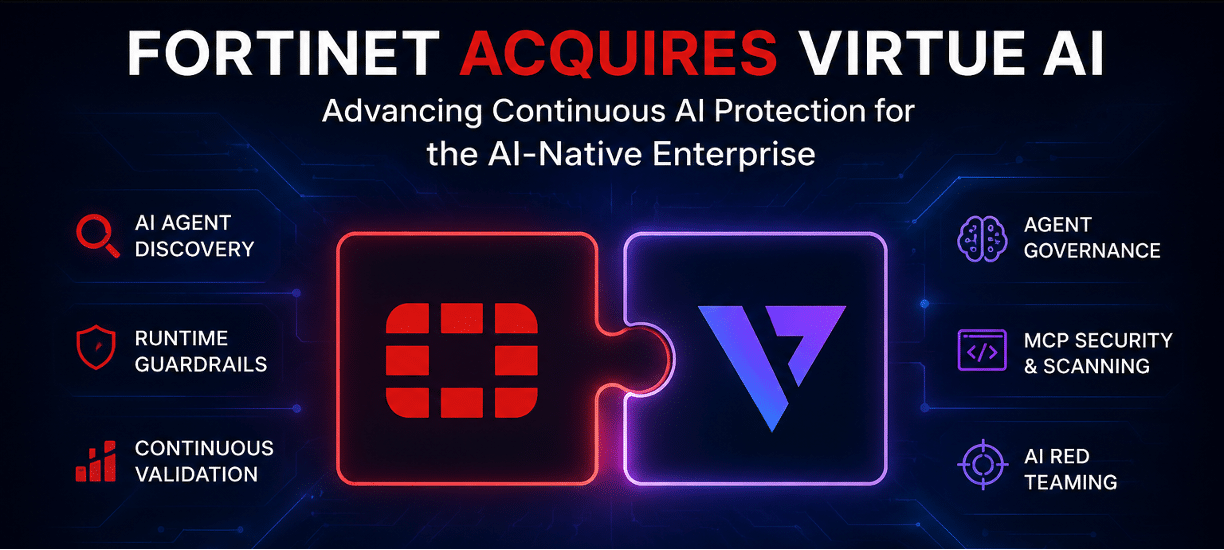
Fortinet’s acquisition of Virtue AI brings another major cybersecurity vendor into the race to secure enterprise AI. But how does the Virtue AI approach compare with Zscaler, Palo Alto Networks and the more advanced emerging AI-native security architectures?
As enterprises increasingly integrate AI into their operations, the importance of robust security measures only grows. With the potential for AI to revolutionize industries, the cybersecurity landscape must evolve. This section explores the implications of AI in cybersecurity, the challenges it brings, and how companies are adapting their strategies to incorporate AI safely.
The Incumbent Giants: Zscaler and Palo Alto Networks
Incumbents may seem a safe bet but they rarely have the best new technology and often don’t do a good job of integrating new companies they buy to try and jump start their position. For years, Zscaler and Palo Alto Networks have dominated the cloud security landscape. Their approach to AI security is largely an extension of their existing SASE (Secure Access Service Edge) and SSE (Security Service Edge) frameworks. They focus on visibility—identifying “Shadow AI” (unauthorized use of LLMs like ChatGPT) and applying data loss prevention (DLP) rules to prevent sensitive data from being leaked into public models.
For instance, consider how Zscaler’s focus on visibility allows organizations to better understand unauthorized AI usage. By implementing machine learning algorithms, Zscaler can analyze patterns of behavior that may indicate the misuse of AI resources. This proactive approach aids in identifying potential risks before they escalate into security incidents.
Palo Alto Networks leverages its Precision AI™ to analyze telemetry across the network, endpoint, and cloud, aiming to block malicious AI-generated content in real-time. Zscaler, meanwhile, focuses on the “AI Data Lasso,” ensuring that data flowing to AI applications is governed by strict zero-trust policies. While robust, these approaches are often reactive, treating AI as just another set of applications to be firewalled.
Moreover, Palo Alto Networks provides case studies demonstrating the effectiveness of Precision AI™ in real-world scenarios. For example, a financial institution reported a significant decrease in AI-related security breaches after adopting these advanced analytics. This illustrates the tangible benefits of investing in AI security measures.
Virtue AI: The Agentic Shift
Fortinet’s acquisition of Virtue AI, represents a shift toward securing the behavior of AI. As enterprises move from simple chatbots to autonomous AI agents, the security challenge changes. Fortinet’s acquisition of Virtue AI focuses on AI agent security and runtime protection, ensuring that when an AI agent acts on behalf of a user, it doesn’t exceed its permissions or fall victim to prompt injection attacks. This “agentic AI security” is critical for the next wave of automation.
Fortinet’s acquisition of Virtue AI strategic focus on agent security is further illustrated by their innovative use of machine learning to detect anomalous behavior in AI agents. This technology constantly learns and adapts, providing a dynamic defense mechanism against emerging threats. As AI capabilities expand, this level of security becomes indispensable for organizations seeking to leverage AI safely.
The Fourth Approach: Veraify powered by Cloudbrink
While the giants focus on the perimeter and Virtue AI focuses on the agent, a new architectural challenge has emerged: the AI Runtime Environment. This is where Veraify powered by Cloudbrink enters the conversation.
Veraify powered by Cloudbrink also represents a significant shift in how organizations perceive AI security. The platform’s ability to handle real-time data processing ensures that security protocols keep pace with rapid AI advancements. This is critical as businesses increasingly rely on AI for mission-critical applications.
Veraify takes an AI-native approach to security by focusing on the high-performance, low-latency requirements of modern AI workloads. Unlike traditional VPNs or legacy SSE providers that add significant latency, Veraify uses a distributed “FAST” (Flexible, Autonomous, Smart, Temprary) edge. This ensures that security checks—including MCP (Model Context Protocol) security and data sanitization—happen as close to the user and the model as possible.
By integrating deep visibility into the runtime execution of AI models, Veraify provides a level of protection that goes beyond simple DLP. It understands the context of the AI interaction, providing a seamless experience that doesn’t sacrifice speed for safety. For organizations looking for Virtue AI alternatives or more agile Zscaler AI security options, Veraify offers a path to secure, high-performance AI adoption.
Furthermore, Veraify’s approach to integrating security at the AI runtime environment ensures that organizations can harness the full potential of AI without compromising safety. The ability to conduct security checks in real-time minimizes latency, which is vital for applications requiring immediate responses, such as financial transactions and healthcare diagnostics.
Conclusion: Which Approach Is Best?
Fortinet’s acquisition of Virtue AI demonstrates how quickly AI security is becoming a strategic enterprise security category.
The acquisition of Virtue AI by Fortinet can be seen as a strategic move to enhance their existing security solutions by integrating advanced AI capabilities. This acquisition not only broadens Fortinet’s product offerings but also positions them as a leader in the evolving cybersecurity landscape.
It also reinforces why buyers need to look beyond traditional security boundaries.
AI exists in cloud infrastructure and enterprise applications, but it also increasingly exists alongside users—in browsers, development tools, desktop applications and local AI assistants.
As AI continues to infiltrate various aspects of business operations, the need for comprehensive security measures spanning across cloud services and on-premise applications has never been clearer. Organizations must develop strategies that address these challenges holistically.
Veraify powered by Cloudbrink is designed to secure that distributed AI environment by bringing together AI visibility, AI governance, sensitive-data protection, Zero Trust access and high-performance connectivity.
The question for security teams is therefore no longer simply:
“How do we secure our AI?”
It is:
“How do we secure every place where our people, data, applications and AI interact?”
That is the architectural question enterprises should put at the center of an AI security evaluation.
Ultimately, the architectural question for enterprises revolves around establishing a security paradigm that not only defends against current threats but also anticipates future challenges posed by the rapid evolution of AI technologies.
Evaluate Veraify
See how Veraify powered by Cloudbrink can provide visibility and control across AI services, endpoints, users, applications and AI agents while maintaining high-performance secure access.
Understanding the capabilities and limitations of platforms like Veraify can help organizations make informed decisions. By evaluating the effectiveness of different security approaches, businesses can ensure they are well-equipped to handle the complexities of AI integration.
Request a Veraify demonstration or proof of value.
In conclusion, as we discuss Fortinet’s acquisition of Virtue AI, it becomes evident that the future of cybersecurity will be deeply intertwined with AI advancements. Organizations need to stay ahead of the curve by embracing innovative solutions that not only address current security challenges but also prepare them for an increasingly AI-driven world.