
Enterprises Need More Than AI Security. They Need Secure AI Access.
Over the past two years, we’ve watched enterprises race from AI experimentation to AI deployment.
What started as a few employees like myself using Jasper and then ChatGPT has evolved into something much larger that can be quite scary:
- AI copilots accessing enterprise data
- Autonomous agents performing business workflows
- Internal LLMs trained on proprietary (and sometime confidential) information
- GPU clusters running mission-critical AI applications
- Developers building and deploying AI-powered services at scale
Unfortunately, most organizations are trying to secure these new AI environments using security architectures that were designed for a completely different world.
The result is growing risk, increasing complexity, and a widening gap between AI innovation and AI governance.
The problem is not simply AI security.
The problem is Secure AI Access.
What Is Secure AI Access?
Secure AI Access is the discipline of controlling, protecting, governing, and accelerating interactions between:
- Users
- AI Agents
- AI Applications
- AI Models
- Enterprise Data
- GPU Infrastructure
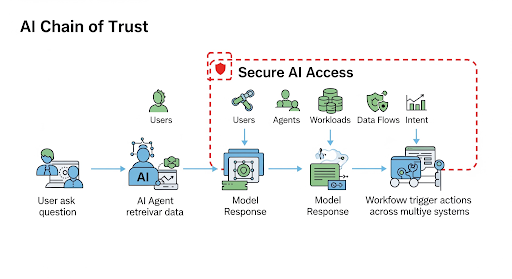
Every AI interaction creates a chain of trust.
A user asks a question.
An AI agent retrieves data.
A model generates a response.
A workflow triggers actions across multiple systems.
Each step introduces new risks.
Traditional security solutions were built to verify users.
Secure AI Access must verify users, agents, workloads, data flows, and intent.
Why Traditional Security Architectures Are Failing
Most enterprise security architectures were built around three assumptions:
- Humans are the primary actors.
- Applications are predictable.
- Network traffic follows known patterns.
AI breaks all three assumptions.
Today:
- Agents make decisions without human intervention.
- Models consume and generate massive amounts of data.
- AI traffic often moves across cloud environments, APIs, SaaS platforms, and GPU infrastructure.
- Users interact with dozens of AI services outside traditional IT visibility.
This creates a new attack surface that existing VPNs, CASBs, firewalls, and legacy security tools were never designed to handle.
The Rise of Shadow AI
One of the biggest challenges facing enterprises today is Shadow AI.
Employees are using:
- ChatGPT
- Claude
- Gemini
- Perplexity
- GitHub Copilot
- Hundreds of specialized AI tools
Many of these applications never pass through traditional governance processes.
- Blocking AI usage rarely works.
- Employees will find alternative tools.
- Developers will route around restrictions.
- Business units will deploy AI solutions without IT involvement.
- The answer is not to stop AI adoption.
- The answer is to enable AI safely.
Organizations need visibility into how AI is being used, what data is being shared, and which AI systems are interacting with enterprise assets.
AI Agents Change Everything
The next phase of AI adoption is not about chatbots.
It is about autonomous agents.
AI agents can:
- Access enterprise applications
- Query databases
- Generate reports
- Execute workflows
- Communicate with other agents
These agents increasingly operate without direct human supervision.
This creates a fundamental challenge.
If organizations require identity verification for employees, why would they not require identity verification for AI agents?
AI agents need:
- Identity
- Authentication
- Authorization
- Continuous verification
- Auditability
In other words, AI agents need Zero Trust.
Why AI Governance Starts With Visibility
You cannot govern what you cannot see.
Before an organization can implement AI policies, it must first answer several questions:
- Which AI tools are being used?
- Which users are accessing them?
- What prompts are they using?
- What data is being shared?
- Which agents are operating within the environment?
- Which models are interacting with sensitive information?
Many organizations discover they have hundreds of AI interactions occurring every day that are completely invisible to security teams.
AI governance begins with full visibility.
Only then can organizations implement meaningful controls.
AI Infrastructure Is Now Part of the Security Conversation
Many AI security discussions focus on prompts, models, and applications.
Few focus on infrastructure.
Yet AI infrastructure is rapidly becoming one of the most critical assets in the enterprise.
Organizations are investing millions of dollars into:
- GPU clusters
- AI training environments
- Retrieval systems
- AI data platforms
- Private AI deployments
These resources require the same protections traditionally applied to sensitive databases and business-critical applications.
Secure AI Access extends security controls beyond users and applications to the underlying AI infrastructure itself.
Performance Is a Security Requirement
One lesson we’ve learned repeatedly is that users bypass security when security slows them down.
When security introduces friction:
- Users seek shortcuts.
- Developers bypass controls.
- Shadow IT emerges.
- Shadow AI follows.
Security and productivity cannot be treated as competing objectives.
They must work together.
Organizations need security architectures that provide:
- Visibility
- Governance
- Compliance
- Data protection
without sacrificing user experience.
This is particularly important for AI, where latency directly impacts adoption and productivity.
Performance is no longer just an operational concern.
Performance has become a security requirement.
The Future of Secure AI Access
Enterprise AI adoption is still in its early stages.
Over the next several years we will see:
- More autonomous agents
- More AI-to-AI interactions
- More distributed inference environments
- More private AI deployments
- More regulatory oversight
The organizations that succeed will not be those that block AI.
They will be the organizations that embrace AI while maintaining governance, visibility, and control.
Secure AI Access represents the next evolution of enterprise security.
It brings together:
- AI Runtime Security
- AI Governance
- AI Agent Security
- AI Access Gateways
- AI Compliance
- Zero Trust Connectivity
- AI Infrastructure Protection
into a unified framework for the AI-driven enterprise.
The future belongs to organizations that can safely accelerate AI adoption rather than restrict it.
Secure AI Access is how they get there.
Frequently Asked Questions about Secure AI Access
What is Secure AI Access?
Secure AI Access is the practice of protecting and governing interactions between users, AI agents, AI applications, models, enterprise data, and AI infrastructure.
Why is Secure AI Access important?
AI introduces new risks including data leakage, prompt injection, shadow AI, unauthorized agent activity, and exposure of sensitive infrastructure. Secure AI Access helps organizations address these risks while enabling productivity.
How is Secure AI Access different from traditional cybersecurity?
Traditional cybersecurity focuses primarily on users and applications. Secure AI Access extends protection to AI agents, models, prompts, inference workflows, and AI infrastructure.
What technologies are part of Secure AI Access?
Common components include AI Runtime Security, AI Governance, AI Access Gateways, Zero Trust Architecture, AI Compliance Controls, Data Protection, and AI Infrastructure Security.
What is the relationship between Secure AI Access and Zero Trust?
Zero Trust provides the foundational principle of continuous verification. Secure AI Access extends Zero Trust concepts beyond human users to AI agents, workloads, models, and infrastructure.