AI Runtime Security
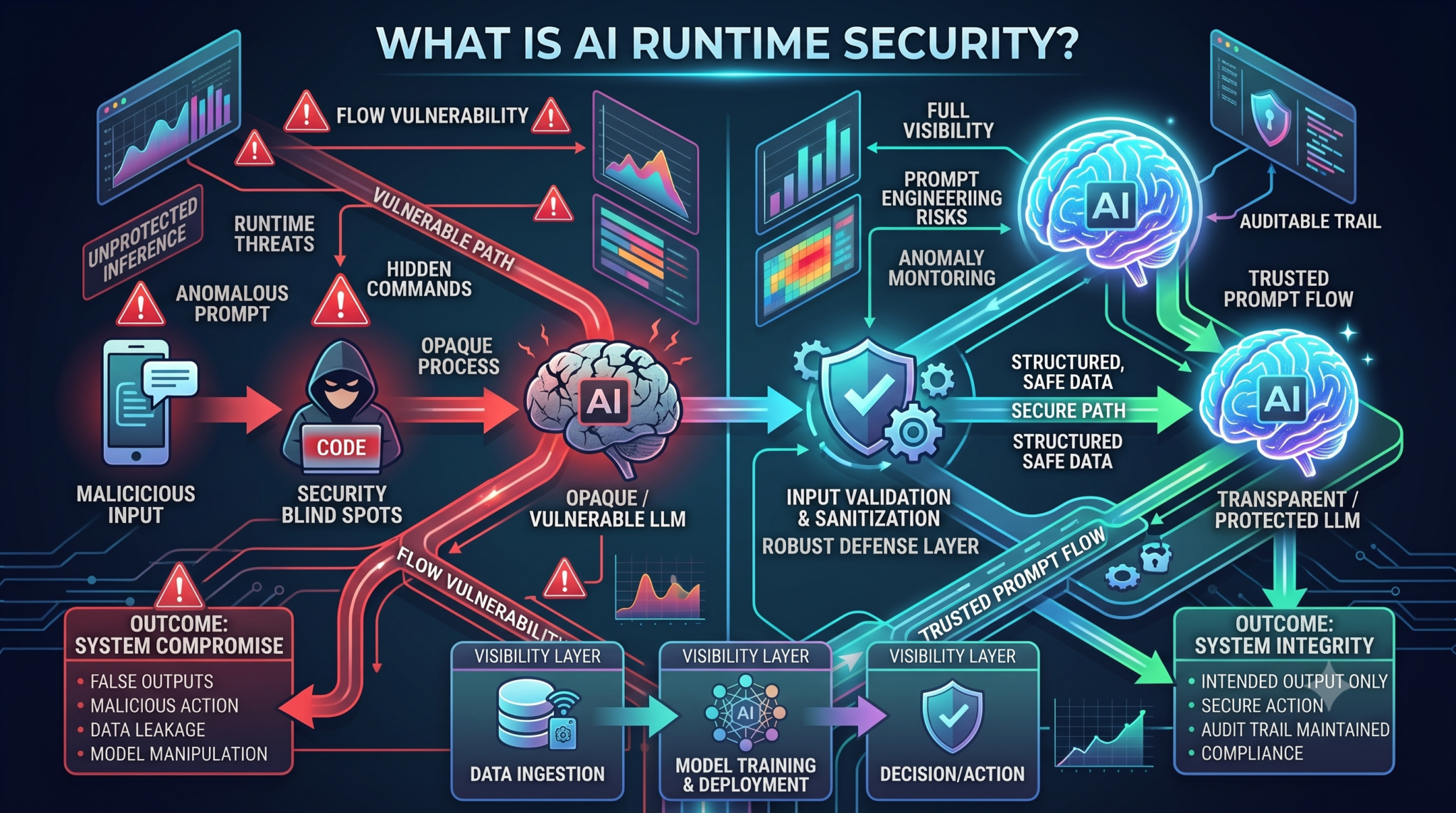
AI Runtime Security is the practice of protecting AI systems while they are actively running, rather than only securing them during development or deployment.
Think of it this way:
| Traditional Security | AI Runtime Security |
|---|---|
| Protects applications, networks, and endpoints | Protects AI models, AI agents, prompts, responses, and AI interactions |
| Focuses on malware, vulnerabilities, and unauthorized access | Focuses on prompt injection, data leakage, agent abuse, model misuse, and unsafe AI behavior |
| Usually monitors applications | Monitors AI activity in real time |
Why AI Runtime Security Exists
Traditional security tools were designed for:
- Users
- Browsers
- Applications
- Servers
AI introduces new risks:
- Employees pasting confidential data into AI tools
- AI agents accessing sensitive systems
- Prompt injection attacks
- Unauthorized AI applications (“Shadow AI”)
- AI assistants running locally on endpoints
- AI models exposing sensitive information
- Autonomous agents making actions without proper controls
As enterprises adopt AI, security teams need visibility and controls during the AI interaction itself. This is where AI Runtime Security comes in.
Core Capabilities of AI Runtime Security
1. AI Visibility
Discover:
- Which AI applications are being used
- Which users are accessing them
- Where they are being accessed from
- Whether usage complies with company policy
Examples:
- ChatGPT
- Claude
- Gemini
- Perplexity
- Custom AI agents
AI usage visibility is often the first step because many organizations don’t know how much AI is already being used.
2. Prompt and Data Protection
Inspect prompts before they leave the device or organization.
Examples:
- Customer records
- Source code
- Financial data
- Intellectual property
- Healthcare data
This is sometimes called request-side DLP (Data Loss Prevention) because it prevents sensitive data from being sent to AI systems.
3. AI Agent Security
Control what AI agents can access.
Examples:
- Databases
- Internal applications
- APIs
- SaaS services
- Cloud resources
Modern AI agents often need access to enterprise data. Runtime security applies:
- Zero-trust access
- Authentication
- Authorization
- Activity monitoring
to those agent interactions.
4. Policy Enforcement
Allow organizations to:
- Allow approved AI tools
- Block risky AI tools
- Restrict file uploads
- Control copy/paste behavior
- Enforce compliance requirements
5. Runtime Threat Detection
Detect:
- Prompt injection attempts
- Data exfiltration
- Unsafe agent actions
- Suspicious AI behavior
- Unauthorized AI applications
AI Runtime Security vs AI Security Posture Management (AI-SPM)
Many vendors combine these categories:
| AI-SPM | AI Runtime Security |
|---|---|
| Finds configuration risks | Protects live AI activity |
| Assesses AI environments | Monitors AI interactions |
| Audits AI deployments | Enforces policies in real time |
| Governance-focused | Operational protection-focused |
Many modern platforms combine both approaches.
How Veraify powered by Cloudbrink Uses AI Runtime Security
Veraify powered by Cloudbrink positions itself as an AI Runtime Security Platform that focuses on:
- AI usage visibility
- Sensitive data protection
- AI-aware policy controls
- Protection of local AI assistants and AI agents
- Zero-trust access to AI resources
- Governance and compliance controls
- Endpoint-level inspection rather than relying solely on cloud proxies
The architecture is designed to secure both:
- Enterprise AI systems running in cloud or data center environments.
- AI tools running directly on user endpoints, including local AI assistants, coding copilots, browser-based AI, and agentic AI workflows.
A Simple Definition
AI Runtime Security is the set of technologies that monitor, govern, and protect AI interactions, agents, prompts, models, and data in real time while AI systems are operating.
It’s becoming the AI equivalent of what endpoint protection, web security, and application security became for traditional IT environments.