By 2027, enterprise AI security will look very different from traditional cybersecurity. The enterprise will no longer be protecting only users, endpoints, and applications — it will be protecting an ecosystem of:
- AI agents
- foundation models
- AI applications
- APIs
- enterprise data
- autonomous workflows
- AI infrastructure
The security architecture shifts from:
Protect the network perimeter
to:
Govern intelligence, data, and autonomous actions everywhere
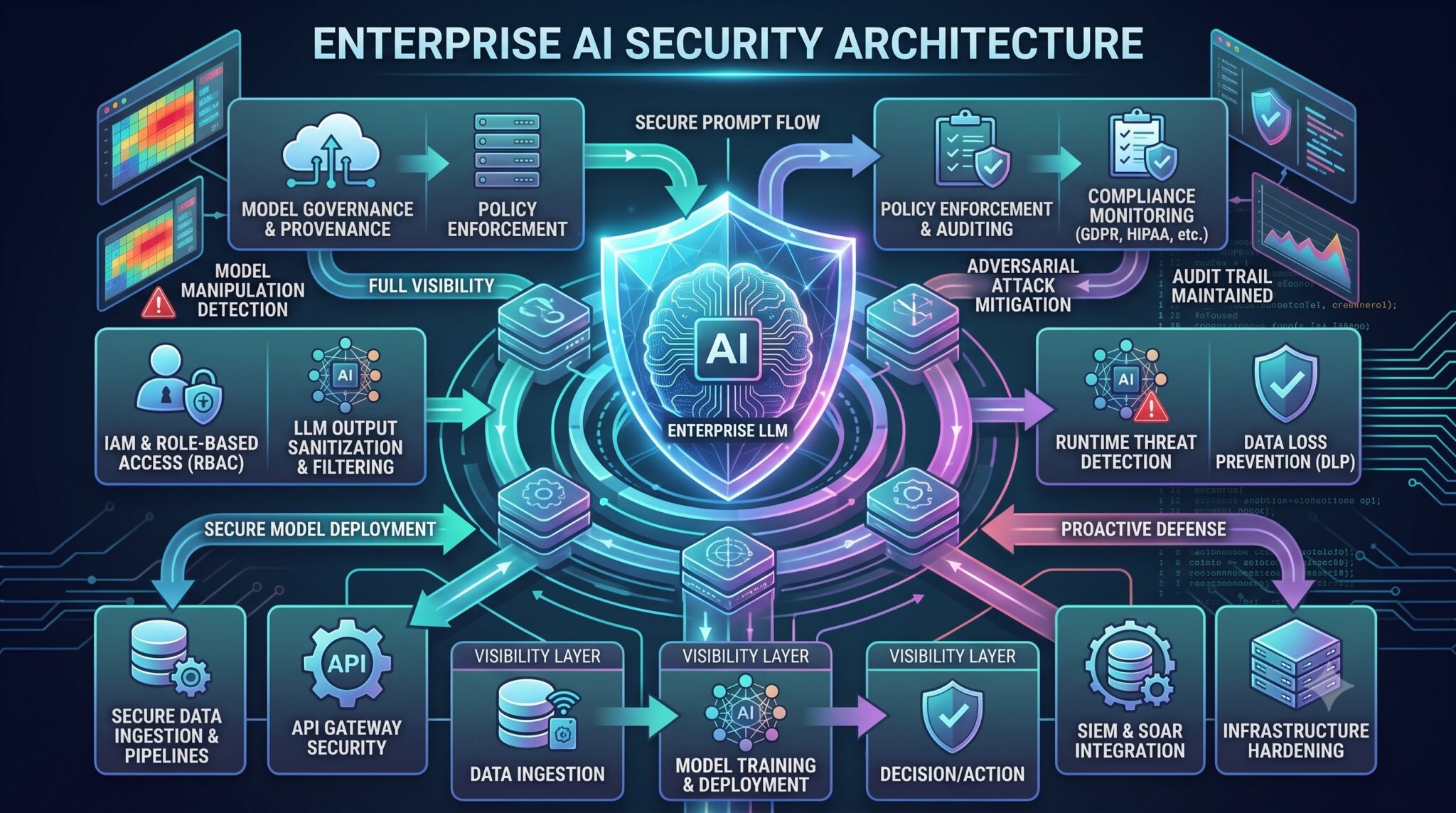
2027 Enterprise AI Security Architecture
                    Enterprise AI Governance Layer
                         (AI TRiSM)
                              │
                              ▼
             AI Security Control & Policy Plane
                              │
 ┌───────────────────────────────────────────────────┐
 │                 AI Runtime Security               │
 │                                                   │
 │  Agent Identity | Behavior | Data Controls        │
 │  Prompt Security | Tool Access | Policy           │
 └───────────────────────────────────────────────────┘
          │                 │                 │
          ▼                 ▼                 ▼

   AI Agents          AI Applications       AI Models
       │                    │                    │
       └──────────────┬─────┴──────────────┘
                      ▼

              Enterprise Data Layer
                      │
                      ▼

          AI Infrastructure Security
     (Cloud | GPUs | Containers | APIs)
1. AI Identity Layer: Every Agent Becomes a Security Principal
In 2027, organizations will manage thousands of AI identities:
- employee AI assistants
- autonomous workflow agents
- coding agents
- security agents
- customer-facing agents
Every agent will need:
- identity
- ownership
- authentication
- authorization
- lifecycle management
The question changes from:
“Who logged in?”
to:
“Which AI agent performed this action, and was it allowed?”
Veraify applies zero-trust access concepts to AI agents and secure access to SaaS and private resources.
2. AI Runtime Security Layer
This becomes the operational security layer for AI.
It monitors AI while it is running:
Agent behavior
- Is the agent acting normally?
- Is it escalating privileges?
- Is it accessing unusual systems?
Data movement
- What information enters the model?
- What information leaves?
Tool usage
- Which APIs are being called?
- Which actions are being executed?
Traditional security tools were designed around human-driven workflows. AI introduces machine-generated, API-driven, autonomous activity.
3. AI-SPM: Continuous AI Posture Management
AI-SPM becomes the inventory and risk foundation.
It discovers:
- models
- agents
- AI applications
- integrations
- data connections
It evaluates:
- permissions
- exposure
- configuration
- ownership
Example:
An enterprise discovers:
- 400 AI tools in use
- 80 unmanaged agents
- 15 exposed model endpoints
AI-SPM identifies the risk before runtime problems occur.
4. Data Security Becomes AI-Aware
Data protection changes because AI creates new leakage paths.
Sensitive data can move through:
- prompts
- context windows
- embeddings
- agent memory
- API calls
- model outputs
Security must understand:
- what data is being used
- why it is being used
- where it goes
Veraify focuses on AI usage visibility, AI-aware controls, and sensitive data protection.
5. Zero Trust Extends to AI
Zero Trust expands from:
Users + Devices
to:
Users + Devices + Agents + Models + Workloads
Every request is evaluated based on:
- identity
- context
- permissions
- risk
- policy
Agent-to-agent communication will require:
- authenticated identities
- encrypted channels
- continuous verification
Veraify uses mutual TLS 1.3-based secure access mechanisms for protected AI connectivity.
6. AI Infrastructure Security
AI infrastructure becomes a critical security layer:
- GPU clusters
- model servers
- containers
- AI APIs
- cloud AI services
Security teams need visibility into:
- where models run
- what they access
- how they communicate
- whether environments are secure
Veraify includes AI infrastructure posture assessment concepts for AI hosting environments.
7. Distributed Enforcement Replaces Centralized Inspection
AI traffic is different:
- API-driven
- machine-generated
- high volume
- latency-sensitive
Sending all AI traffic through centralized inspection points can create:
- latency
- bottlenecks
- unnecessary routing
Future architectures move enforcement closer to:
- users
- endpoints
- workloads
- AI services
The 2027 AI Security Stack
| Layer | Purpose |
|---|---|
| AI TRiSM | Governance, compliance, risk |
| AI-SPM | Discover and secure AI assets |
| AI Runtime Security | Protect AI activity in execution |
| Zero Trust | Control identities and access |
| Data Security | Prevent AI data leakage |
| Infrastructure Security | Protect models and compute |
| Observability | Understand AI behavior |
The Future Enterprise Model
By 2027, the enterprise will operate with:
Humans define objectives
↓
AI agents execute workflows
↓
Security controls govern actions
↓
AI systems continuously verify trust
The organizations that succeed will not be the ones that block AI — they will be the ones that can securely operationalize autonomous intelligence at scale.