For years, cybersecurity teams have operated on a simple principle:
You cannot protect what you cannot see.
That principle has become even more important in the age of AI.
Before organizations can enforce AI policies, prevent data leaks, or secure AI agents, they first need to answer a basic question:
How is AI actually being used inside the business?
For many organizations, the honest answer is: they don’t know.
The AI Adoption Problem
AI adoption is happening faster than most security teams can track.
Employees are:
- Using public AI assistants
- Uploading documents for analysis
- Using AI coding tools
- Installing AI browser extensions
- Experimenting with AI agents
- Connecting AI systems to internal data sources
Often, these activities occur without formal approval from IT or security.
This creates a growing gap between what security teams think is happening and what is actually happening.
The Hidden Risk of Shadow AI
The biggest AI security challenge is often not a sophisticated attack.
It’s the AI usage that nobody knows about.
Employees frequently adopt AI tools because they help them:
- Work faster
- Write content
- Analyze data
- Create code
- Automate repetitive tasks
Unfortunately, those same tools may also gain access to:
- Customer information
- Intellectual property
- Financial data
- Source code
- Internal business documents
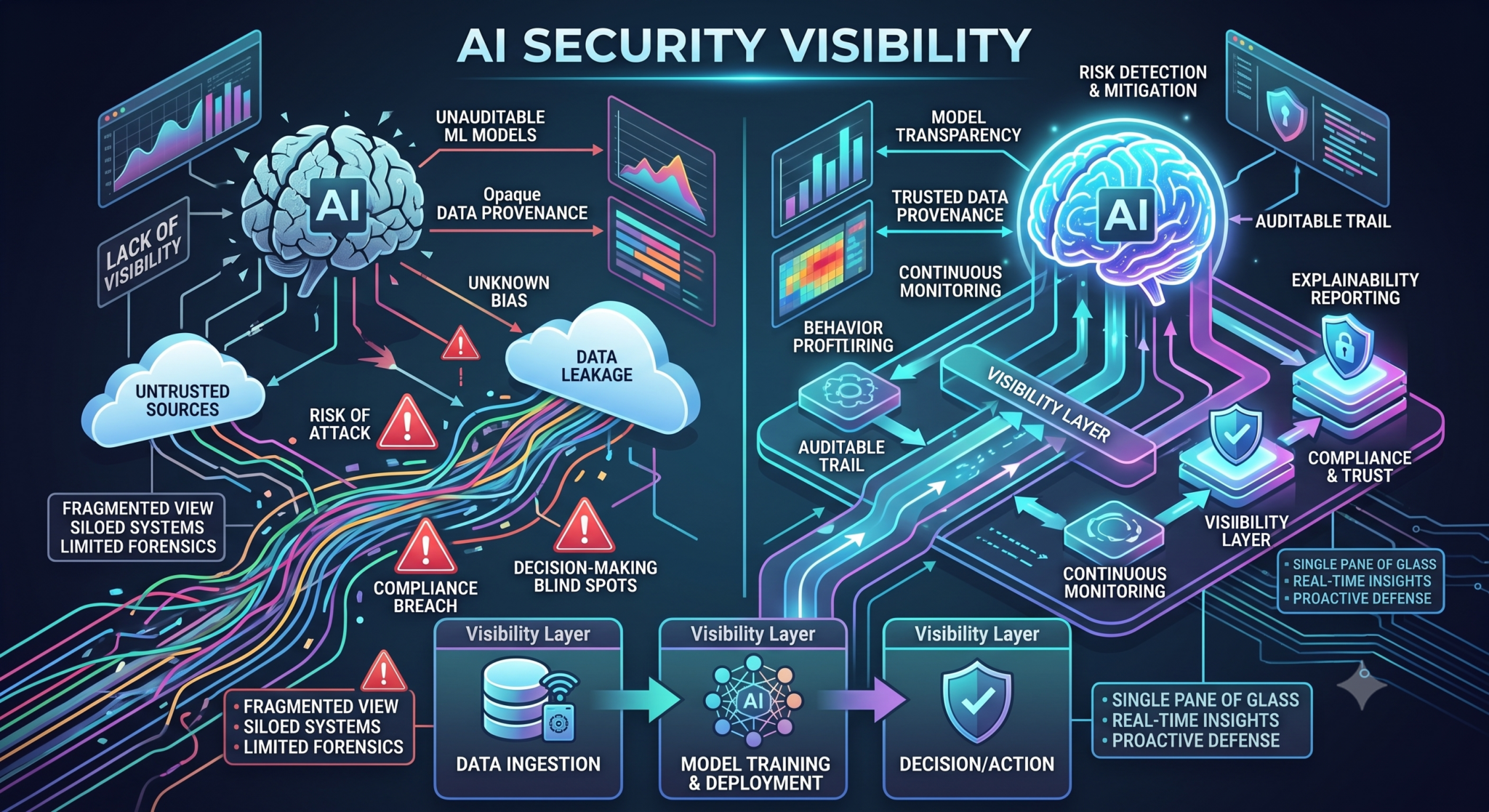
Without visibility, security teams cannot determine:
- Which AI applications are in use
- Which users are using them
- What data is being shared
- Whether usage complies with company policy
This is why AI visibility has become the foundation of modern AI governance. Employees are already using browser-based AI tools, custom AI agents, and local AI assistants that may operate outside traditional governance processes.
Visibility Enables Every Other Security Control
Most AI security initiatives fail when organizations start with blocking instead of understanding.
Visibility provides the information needed to make intelligent decisions.
Data Protection
Before you can prevent sensitive data from reaching AI systems, you need to know:
- Which AI tools are receiving data
- What types of information are being shared
- Which users are involved
Without visibility, data protection becomes guesswork.
AI Governance
Organizations need to establish:
- Approved AI applications
- Acceptable use policies
- Compliance requirements
- Risk classifications
These decisions require accurate usage information.
AI Agent Security
Modern AI agents increasingly interact with:
- SaaS applications
- APIs
- Databases
- Internal systems
Visibility helps security teams understand:
- Which agents exist
- What they can access
- What actions they are performing
AI agents require secure access to data and services, making visibility into their activity a critical part of governance and security.
The New Visibility Challenge: AI Beyond the Browser
Traditional security visibility focused on:
- Web traffic
- Applications
- Devices
- Networks
AI introduces entirely new visibility challenges.
Organizations now need visibility into:
- AI prompts
- AI uploads
- AI-generated actions
- AI agents
- AI APIs
- Local AI assistants
- Agent-to-agent communications
Many of these interactions bypass traditional monitoring tools.
For example, local AI assistants running directly on endpoints may access files, clipboard data, browser content, and enterprise resources without ever passing through conventional cloud inspection points.
Visibility Helps Balance Security and Productivity
One of the biggest mistakes organizations make is attempting to block all AI usage.
In practice, this rarely works.
Employees often find alternative tools and workarounds, increasing the Shadow AI problem.
Visibility enables a more balanced approach:
Instead of asking:
“How do we stop employees from using AI?”
Organizations can ask:
“How do we enable AI safely?”
This allows security teams to:
- Identify popular AI tools
- Approve low-risk applications
- Restrict high-risk usage
- Apply targeted controls
- Improve user adoption of sanctioned AI platforms
What Good AI Visibility Looks Like
An effective AI visibility strategy should answer questions such as:
AI Application Visibility
- Which AI applications are being used?
- How often are they used?
- Which departments are using them?
User Visibility
- Who is accessing AI tools?
- From which devices?
- From which locations?
Data Visibility
- What information is being uploaded?
- Is sensitive data involved?
- Are compliance requirements being met?
Agent Visibility
- Which AI agents are active?
- What systems can they access?
- What actions are they performing?
Risk Visibility
- Which AI tools are sanctioned?
- Which represent elevated risk?
- Which require additional controls?
How Veraify Powered by Cloudbrink Approaches Visibility
Veraify powered by Cloudbrink places AI visibility at the center of its AI Runtime Security strategy.
The platform is designed to provide:
- Visibility into AI application usage
- Identification of AI users and activity
- AI-aware policy enforcement
- Sensitive data protection
- Governance controls
- Secure access for AI agents and AI workloads
The goal is to give security teams the context they need before enforcing controls, allowing organizations to secure AI adoption without sacrificing productivity. AI usage visibility is a foundational use case within the Veraify platform and supports broader governance, compliance, and security initiatives.
Key Takeaway
AI security does not begin with blocking, filtering, or enforcement.
It begins with understanding.
Organizations cannot govern AI they cannot see, cannot protect data they cannot track, and cannot secure AI agents they do not know exist.
Visibility provides the foundation for every other AI security capability—from data protection and compliance to runtime security and agent governance.
In the AI-native enterprise, visibility is no longer just a monitoring function.
It is the first step toward secure, responsible, and scalable AI adoption.