
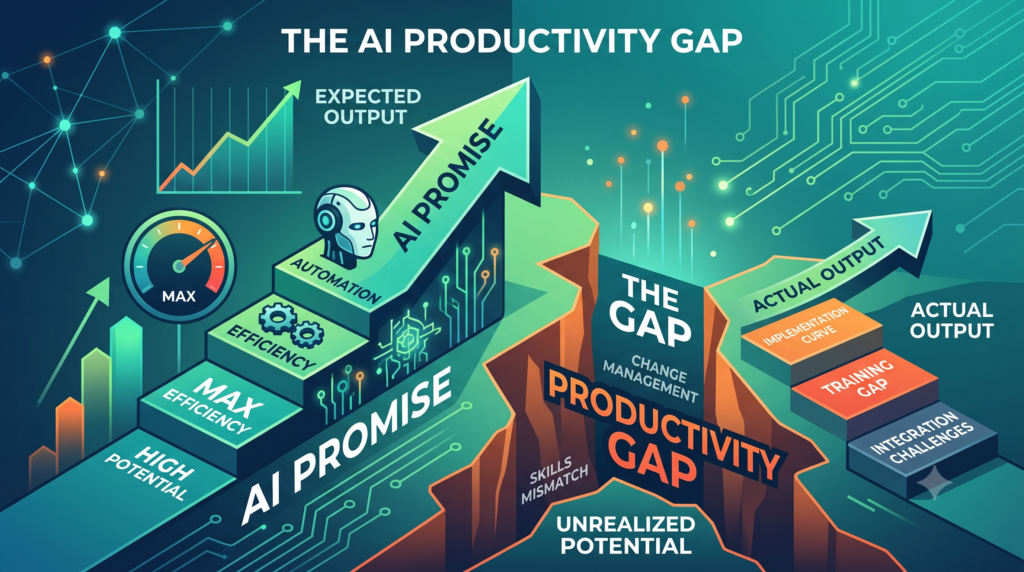
Artificial Intelligence promises dramatic productivity gains. Employees can write reports faster, developers can generate code more quickly, and business users can automate tasks that once took hours.
Yet many organizations are discovering a surprising reality:
The biggest barrier to AI adoption is often not the AI itself—it is the security architecture surrounding it.
As security teams rush to govern AI usage, many organizations are unintentionally creating an AI Productivity Gap: the difference between the productivity AI could deliver and the productivity employees actually experience.
What Is the AI Productivity Gap?
The AI Productivity Gap occurs when security controls introduce so much friction that users either:
- Avoid approved AI tools
- Seek unsanctioned alternatives
- Disable security controls
- Abandon AI-driven workflows altogether
The result is a paradox:
Organizations invest heavily in AI to improve productivity, then deploy controls that reduce the very productivity they hoped to achieve.
Why Traditional Security Architectures Struggle with AI
Most enterprise security platforms were designed for:
- Web browsing
- SaaS applications
- Human-driven workflows
- Centralized inspection models
AI traffic behaves differently.
Modern AI workloads are:
- Highly interactive
- API-driven
- Latency sensitive
- Bandwidth intensive
- Frequently encrypted end-to-end
- Increasingly machine-to-machine
As AI adoption grows, architectures built around centralized inspection and traffic redirection can introduce significant delays and complexity. First-generation SASE and SSE platforms were optimized for browser-centric SaaS traffic, while AI-native workloads increasingly involve direct model access, APIs, autonomous agents, and large volumes of encrypted traffic.
The Cost of Security-Induced Latency on the AI Productivity Gap
Security teams often focus on risk reduction.
Users focus on getting work done.
When AI interactions become slower because traffic is:
- Routed through multiple proxies
- Inspected by centralized gateways
- Redirected through distant cloud points of presence
- Subjected to repeated authentication checks
users notice immediately.
A few hundred milliseconds may seem insignificant for traditional web traffic.
For AI interactions occurring hundreds or thousands of times per day, that latency compounds into a meaningful productivity loss.
This becomes especially noticeable for:
- AI coding assistants
- Real-time copilots
- AI-powered document analysis
- Agentic workflows
- AI-driven customer service tools
The Rise of Shadow AI
When approved AI tools become difficult to use, employees frequently look elsewhere.
This creates Shadow AI.
Users begin adopting:
- Consumer AI applications
- Personal AI subscriptions
- Browser extensions
- Local AI assistants
- Unapproved AI agents
Not because they want to violate policy.
Because they want to work efficiently.
This creates an unfortunate cycle:
- Security introduces restrictions.
- Productivity decreases.
- Users seek alternatives.
- Visibility decreases.
- Risk increases.
The organization’s security posture may actually worsen despite additional controls.
Why Blanket Blocking Doesn’t Work
Many organizations initially respond to AI concerns by attempting to block AI entirely.
This approach often fails because AI is no longer a niche technology.
Employees increasingly rely on AI for:
- Writing
- Research
- Coding
- Analysis
- Customer support
- Content creation
Blocking AI completely is becoming as impractical as blocking web browsers or cloud applications.
Instead, organizations need governance models that enable productive AI usage while maintaining control.
The Hidden Cost of Traffic Hairpinning
One challenge often overlooked is the impact of centralized security architectures on AI traffic – this security method increases te AI productivity gap.
Traditional secure access models frequently route traffic through centralized inspection points before it reaches the intended destination.
For AI workloads, this can introduce:
- Additional latency
- Reduced responsiveness
- Increased bandwidth costs
- Poor user experience
- embedded AI cannot be captured and hair-pinned
These effects become more significant as AI interactions grow in volume and complexity.
AI-native traffic patterns amplify the costs of:
- Traffic hair-pinning
- Centralized proxy inspection
- TLS interception
- Additional network hops
- Cloud redirection architectures
AI Agents Make the Problem Bigger
The AI productivity gap becomes even greater with AI agents.
Unlike traditional applications, AI agents may:
- Access multiple systems
- Query APIs
- Retrieve documents
- Execute workflows
- Communicate with other agents
Each additional security checkpoint can compound latency and reduce the effectiveness of automation.
As organizations move toward agentic AI, balancing security and performance becomes increasingly important.
What Security Teams Should Optimize For
The goal should not be:
Maximum restriction.
The goal should be:
Maximum safe productivity.
That requires balancing:
Visibility
Know which AI tools are being used.
Governance
Apply policies appropriate to risk.
Data Protection
Protect sensitive information before it leaves the organization.
User Experience
Ensure approved AI tools remain fast and easy to use.
Zero-Trust Access
Secure access to enterprise resources without introducing unnecessary friction.
How Veraify Powered by Cloudbrink Approaches the Problem
Veraify powered by Cloudbrink was designed around the idea that security and productivity should not be competing priorities. It reduces the AI productivity gap.
The platform combines:
- AI Runtime Security
- AI visibility
- AI-aware policy controls
- Sensitive data protection
- High-performance secure access
- Zero-trust networking
Unlike architectures that rely heavily on centralized inspection and traffic redirection, Veraify is designed to apply governance and security controls while maintaining low-latency access for users, AI applications, and AI agents. The platform’s architecture emphasizes distributed enforcement, direct connectivity, and high-performance transport optimized for AI workloads.
The objective is not simply to secure AI.
It is to secure AI without creating the friction that drives users toward Shadow AI.
Key Takeaway
The organizations that succeed with AI will not be the ones with the strictest controls.
They will be the ones that strike the right balance between security and productivity.
When security slows AI down, users find ways around it.
When security enables safe, fast, governed AI adoption, organizations gain both protection and productivity.
The future of AI security is not about choosing between innovation and control.
It is about building architectures that deliver both security and productivity – one that reduces the AI productivity gap.