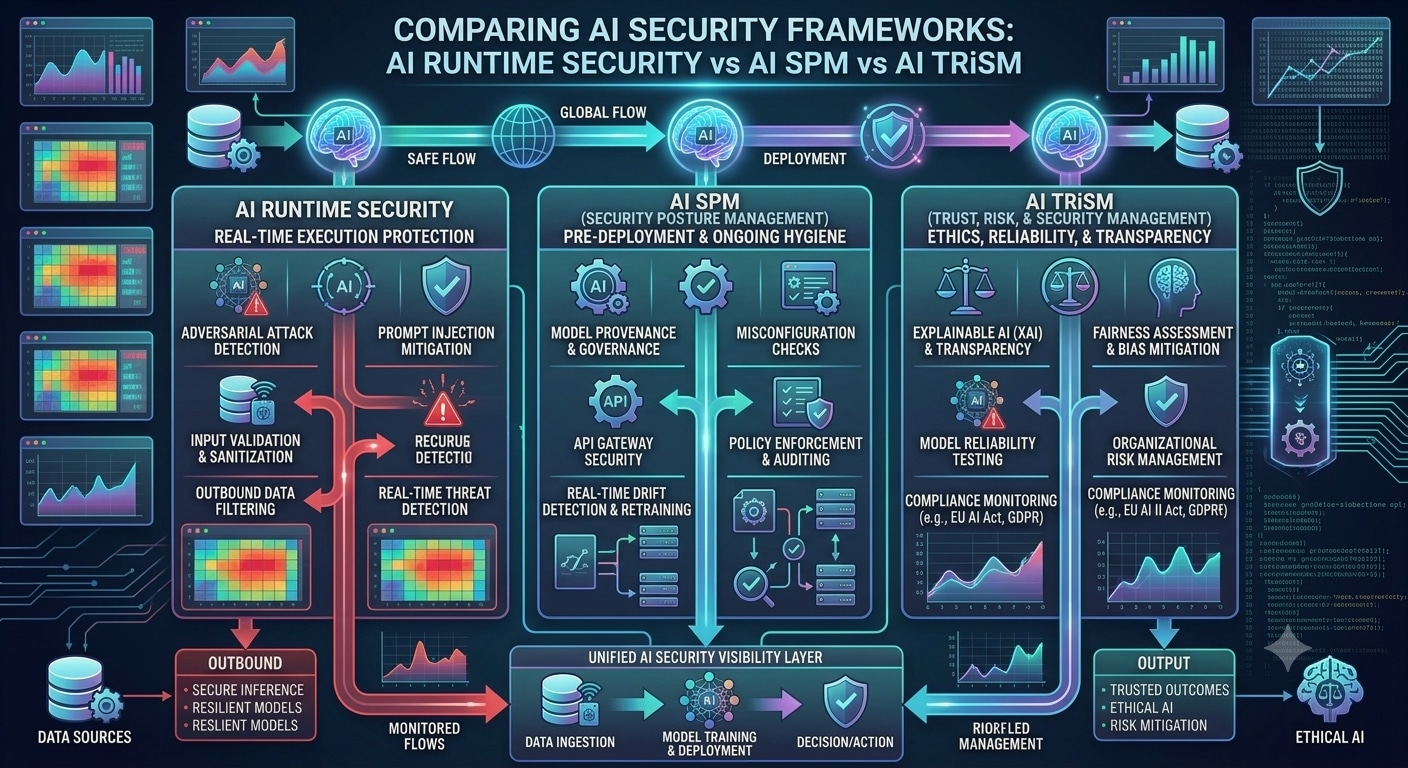
These three terms describe overlapping but different parts of the emerging AI security market. The simplest distinction:
- AI-SPM = Where is my AI? Is it configured securely?
- AI Runtime Security = What is my AI doing right now? Is it behaving safely?
- AI TRiSM = How do I govern and manage AI risk across the organization?
| Area | AI-SPM | AI Runtime Security | AI TRiSM |
|---|---|---|---|
| Focus | AI security posture | AI activity and protection during execution | Enterprise AI governance and risk |
| Time perspective | Before deployment | During operation | Continuous lifecycle |
| Main question | “Is AI configured safely?” | “Is AI behaving safely right now?” | “Can we trust AI at scale?” |
| Primary users | Security, cloud, AI platform teams | Security operations, IT, AI teams | CISO, risk, compliance, governance teams |
| Protects | AI assets and configurations | AI agents, models, data flows, interactions | People, processes, policies, compliance |
1. AI-SPM (AI Security Posture Management)
AI-SPM is focused on discovering and securing AI assets.
It answers:
- What AI models do we have?
- Where are they running?
- Who has access?
- What data can they reach?
- Are configurations secure?
Examples:
- Finding unmanaged AI applications
- Detecting exposed AI endpoints
- Reviewing model permissions
- Identifying risky AI integrations
Think:
“Inventory + posture + configuration management”
2. AI Runtime Security
AI Runtime Security protects AI while it is being used.
AI systems are dynamic:
- users submit prompts
- agents call tools
- models access data
- APIs exchange information
Runtime security monitors and controls:
- AI interactions
- agent behavior
- data movement
- model access
- policy violations
The Veraify AI security model is positioned as an AI Runtime Security Platform / AI-SPM category, combining AI visibility, AI-aware controls, sensitive data protection, and secure connectivity.
Examples:
An employee uploads confidential data into an AI assistant:
- AI-SPM might identify the assistant exists
- Runtime security can detect the sensitive data being sent and enforce policy
3. AI TRiSM (AI Trust, Risk and Security Management)
AI TRiSM is broader.
It covers the organizational framework for trustworthy AI:
- governance
- compliance
- risk management
- transparency
- explainability
- model controls
- lifecycle management
It answers:
“Should this AI system be allowed to operate in the business?”
Examples:
- AI approval processes
- regulatory controls
- AI risk assessments
- audit reporting
- responsible AI policies
How They Work Together
A mature AI security architecture needs all three:
AI TRiSM
(Strategy, governance, risk)

        ↓

AI-SPM
(Discover assets, assess posture)

        ↓

AI Runtime Security
(Protect AI activity in real time)
Where AI Agents Change the Game
AI agents make runtime security increasingly important.
Agents are:
- autonomous
- API-driven
- connected to enterprise systems
- capable of taking actions
They need:
- identity
- least privilege
- secure communication
- continuous verification
Veraify focuses on AI-aware policy enforcement, secure access, and visibility for AI interactions, including AI agents accessing SaaS and private resources.
Simple analogy
AI-SPM = Home inspection
“Is the house built safely?”
AI Runtime Security = Security guard
“What is happening inside right now?”
AI TRiSM = Governance board
“Should this house exist, and what rules apply?”
The future enterprise will likely need all three because AI is becoming an active participant in business operations, not just another application.