
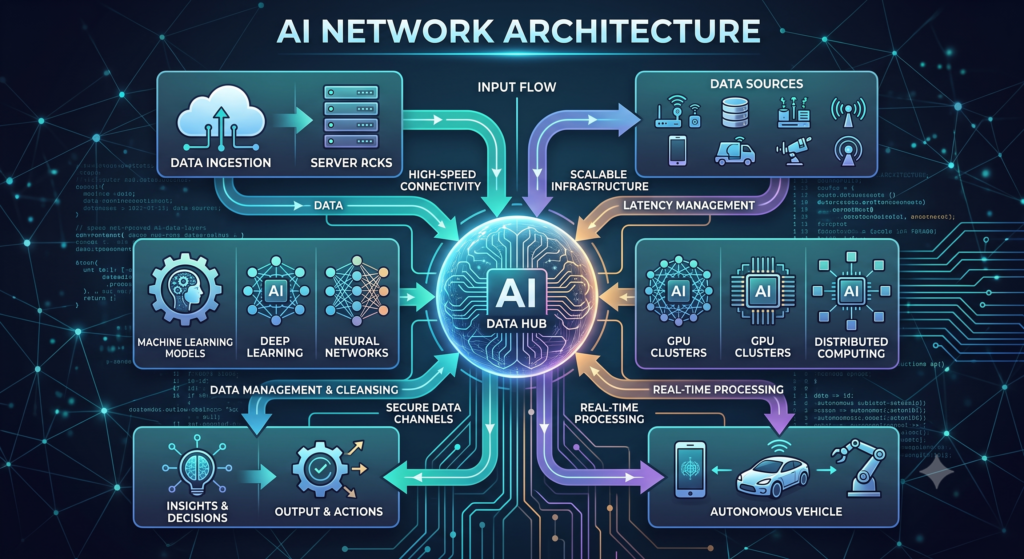
AI Networking can have a big impact on AI productivity.
Artificial Intelligence is changing more than applications, workflows, and user experiences.
The concept of ai networking emphasizes the integration of AI technologies into the networking infrastructure.
It is changing the underlying network traffic patterns that enterprises were built to support.
For decades, enterprise networks were designed around a relatively simple assumption:
People access applications.
In the AI era, that assumption is no longer sufficient.
As companies transition to ai networking, they must adapt their strategies for traffic flow and security management.
Today, organizations must support:
- AI assistants
- AI networking solutions
- AI copilots
- AI agents
- Large Language Models (LLMs)
- Real-time inference
- Agent-to-agent communication
- Massive API traffic
- Distributed AI workloads
As AI becomes embedded in everyday operations, enterprises are discovering that traditional network and security architectures can become a bottleneck rather than an enabler.
With the emergence of ai networking, enterprises are exploring new ways to leverage AI-driven insights for performance optimization.
The Evolution of Enterprise Architecture
Enterprise infrastructure has evolved through several distinct phases.
| Era | Primary Focus | Architecture |
|---|---|---|
| VPN Era | Secure remote access | Centralized perimeter |
| SaaS Era | Cloud applications | SASE and cloud inspection |
| AI Era | AI-native workloads | Distributed AI-aware architecture |
Traditional VPNs assumed users would connect to centralized corporate resources.
SASE and SSE platforms evolved to support cloud applications and internet access.
AI introduces an entirely different traffic model. Enterprise infrastructure is entering a new architectural era in which AI agents, APIs, and distributed workloads operate across users, clouds, applications, and endpoints.
Adopting ai networking can provide a robust framework for handling the increased demand for data processing and management.
AI Traffic Is Fundamentally Different
Most security architectures were designed around human-driven interactions.
AI generates a different class of traffic.
AI workloads are increasingly:
- API-driven
- Machine-generated
- Autonomous
- Real-time
- Encrypted
- Latency-sensitive
- High-volume
Unlike traditional SaaS traffic, AI systems may perform hundreds or thousands of interactions behind the scenes for a single user request.
As the shift to ai networking continues, organizations will need to invest in technologies that support real-time communication and collaboration.
What appears to be one prompt may involve:
- Multiple API calls
- Retrieval operations
- Database queries
- Agent coordination
- Model inference
- External tool execution
This dramatically increases both network demand and architectural complexity. AI-native workloads are increasingly direct-to-model, API-driven, machine-generated, and significantly more bandwidth-intensive than traditional enterprise traffic.
The Latency Problem
AI is extremely sensitive to latency.
Consider an AI coding assistant.
If responses arrive instantly, productivity increases.
AI networking solutions can enable faster response times and improve the overall user experience.
If every interaction experiences delays caused by:
- Traffic redirection
- Multiple proxies
- Centralized inspection
- Additional network hops
the user experience deteriorates rapidly.
The evolution of ai networking will be critical in shaping the next generation of digital transformation.
The same applies to:
- AI copilots
- Real-time assistants
- Voice AI
- AI-powered customer support
- Autonomous agents
A network architecture designed for occasional web requests may struggle when AI systems generate continuous streams of API interactions.
Why Centralized Inspection Becomes a Bottleneck
Many first-generation secure access architectures rely on centralized inspection points.
Traffic is often:
- Sent to a cloud security service.
- Inspected.
- Redirected.
- Forwarded to its destination.
For traditional web traffic, this approach is often acceptable.
For AI workloads, every additional hop adds friction.
AI-native traffic amplifies the cost of:
- Traffic hairpinning
- Tunnel overhead
- Centralized proxy inspection
- TLS interception
- Cloud redirection
As AI adoption increases, these inefficiencies become more visible to users and applications.
AI Agents Change Everything
Organizations leveraging ai networking will likely experience significant competitive advantages.
The rise of agentic AI creates even greater demands.
Unlike human users, AI agents may:
- Operate continuously
- Access multiple applications simultaneously
- Query databases
- Invoke APIs
- AI networking advantages
- Coordinate with other agents
- Execute workflows autonomously
An organization may eventually have thousands of AI agents operating alongside employees.
Networks designed primarily around human activity were never built for this scale of machine-driven communication.
To fully embrace ai networking, teams must focus on enhancing visibility and control over AI-driven processes.
Visibility Challenges in the AI Era
Traditional security visibility focused on:
- Users
- Devices
- Applications
AI introduces new entities that require visibility:
- Models
- Prompts
- Agents
- Agent actions
- AI APIs
- AI-generated traffic
- Local AI assistants
Many AI interactions occur through encrypted channels and direct API connections, making visibility more difficult using conventional monitoring approaches. AI traffic increasingly bypasses traditional visibility models through encrypted model traffic, private AI endpoints, and agent-to-agent communication.
AI networking represents a paradigm shift in how businesses approach network architecture and security.
Security Must Move Closer to the Edge
In traditional architectures, security often sits in centralized gateways.
AI is driving a shift toward distributed enforcement.
Organizations increasingly need:
- Endpoint-level visibility
- AI-aware controls
- Local policy enforcement
- Distributed inspection
- Session-level intelligence
- Context-aware decision-making
Rather than forcing all traffic through centralized chokepoints, security controls can be placed closer to users, devices, applications, and AI workloads.
The Rise of AI-Native Networking
The Importance of AI Networking
AI networking, an essential framework, should be designed around several principles:
Direct Connectivity
Reduce unnecessary traffic redirection.
Low Latency
Optimize for real-time AI interactions.
Distributed Enforcement
Apply security controls closer to endpoints and workloads.
AI Visibility
Provide insight into AI usage, agents, prompts, and interactions.
Zero-Trust Access
Secure access based on identity, device, application, and context.
Scalability
Support massive growth in API traffic and autonomous agent activity.
How Veraify Powered by Cloudbrink Approaches AI-Native Networking
Veraify powered by Cloudbrink was designed around the reality that AI traffic behaves differently from traditional enterprise traffic.
The platform combines:
- AI Runtime Security
- AI visibility
- AI governance
- Zero-trust access
- Distributed policy enforcement
- High-performance secure connectivity
Rather than relying solely on centralized inspection models, Veraify emphasizes distributed intelligence, direct application connectivity, packet-loss optimization, and edge-native enforcement designed to support AI workloads, AI agents, and real-time inference traffic.
This architecture helps organizations maintain both security and performance as AI adoption expands.
Key Takeaway
Future-proofing through ai networking is essential for organizations aiming to thrive in a tech-driven world.
AI is not simply another application category.
It represents a fundamental shift in how traffic is generated, how systems communicate, and how work gets done.
Architectures designed for browsers, VPNs, and traditional SaaS applications are increasingly being asked to support AI agents, autonomous workflows, and machine-scale communications.
The organizations that succeed with AI will be those that recognize this shift early and adopt network architectures built for an AI-native future—one that delivers visibility, governance, security, and performance without forcing organizations to choose between them.
Ultimately, embracing ai networking will not only enhance operational efficiencies but also pave the way for innovation.