AI Compliance Explained: AI is transforming how organizations operate, but it is also creating new compliance challenges. Employees are using AI assistants, developers are building AI agents, and businesses are integrating AI into critical workflows. As a result, security and compliance teams are increasingly asking:
This AI Compliance Explained blog is great for understanding modern regulatory challenges in technology.
“How do we use AI without violating regulatory requirements?”
The answer begins with understanding that AI itself is not usually the compliance problem. The problem is how AI systems access, process, store, transmit, and generate data.
AI Compliance Explained, shows organizations must prioritize how AI systems handle sensitive data.
Why AI Creates New Compliance Risks
Understanding AI Compliance Explained
Traditional compliance frameworks were designed around:
- Applications
- Databases
- Users
- Networks
AI Compliance Explained introduces additional concerns:
- Employees uploading sensitive data into public AI tools
- AI agents accessing regulated systems
- Cross-border movement of data
- Automated decision-making
- AI-generated content
- Lack of visibility into AI usage
- Retention of prompts and conversations
Organizations must now govern not only data but also how AI interacts with that data. Employees are already using browser-based AI tools, custom AI agents, and local AI assistants that may operate outside traditional governance processes.
Understanding AI Compliance Explained helps organizations navigate complex data governance challenges.
GDPR and AI
What is GDPR?
The General Data Protection Regulation (GDPR) governs how organizations collect, process, and protect personal data belonging to individuals in the European Union.
AI Compliance Concerns Under GDPR
AI systems may process:
- Names
- Email addresses
- Customer records
- Employee information
- Behavioral data
- Personal identifiers
Potential risks include:
Unauthorized Data Sharing
Employees may paste personal information into public AI tools.
Cross-Border Data Transfers
Many AI providers process information across multiple regions and jurisdictions.
AI Compliance Explained sheds light on the necessity of transparency in AI operations.
Lack of Transparency
Organizations may not know:
- Which AI systems are being used
- What data is being submitted
- Where that data is stored
Automated Decision-Making
GDPR includes requirements around automated decisions that significantly affect individuals.
GDPR Best Practices for AI
- Maintain AI usage visibility
- Restrict sensitive personal data uploads
- Classify approved AI applications
- Implement data minimization policies
- Maintain audit logs
- Ensure lawful processing of personal data
HIPAA and AI
What is HIPAA?
AI Compliance Explained emphasizes the importance of protecting patient data in healthcare.
The Health Insurance Portability and Accountability Act (HIPAA) regulates protected health information (PHI) in the United States.
AI Compliance Concerns Under HIPAA
Healthcare organizations increasingly use AI for:
- Clinical documentation
- Research
- Administrative automation
- Patient communications
Potential risks include:
PHI Exposure
Employees may upload:
- Patient records
- Medical histories
- Diagnostic information
into AI tools without authorization.
Third-Party Access
AI providers may become part of the PHI processing chain.
Insufficient Controls
Organizations must heed AI Compliance Explained to avoid potential legal repercussions.
Organizations must understand where PHI is processed and whether appropriate safeguards exist.
HIPAA Best Practices for AI
- Detect PHI before it leaves the endpoint
- Restrict AI applications handling healthcare data
- Maintain audit trails
- Validate data residency requirements
- Review vendor agreements and security controls
Organizations evaluating AI security platforms often need to assess how AI inspection, traffic routing, data handling, and existing compliance controls interact with healthcare requirements.
PCI DSS and AI
What is PCI DSS?
The Payment Card Industry Data Security Standard (PCI DSS) governs the protection of payment card information.
AI Compliance Concerns Under PCI
Employees may inadvertently submit:
- Credit card numbers
- Payment records
- Financial transaction data
to AI systems.
Potential risks include:
Cardholder Data Leakage
Sensitive payment information may be exposed through prompts, uploads, or AI interactions.
Lack of Monitoring
Organizations may not know when payment-related information is being shared with AI services.
Third-Party Processing
AI providers handling cardholder data may create additional compliance obligations.
PCI Best Practices for AI
- Detect payment card information before transmission
- Monitor AI application usage
- Apply DLP controls
- Maintain logging and audit records
- Restrict unauthorized AI applications
Emerging AI Regulations
Beyond traditional compliance frameworks, governments are beginning to create AI-specific regulations.The EU AI Act
The European Union Artificial Intelligence Act is one of the first comprehensive AI regulations.
The regulation introduces risk-based requirements for AI systems, including:
- Transparency obligations
- Governance controls
- Documentation requirements
- Risk management processes
- Monitoring and oversight requirements
Organizations deploying AI systems in Europe may need to demonstrate how AI is governed and monitored.
Global AI Governance Initiatives
Keeping abreast of AI Compliance Explained ensures organizations remain competitive and compliant.
Many countries are developing AI-related requirements covering:
- AI transparency
- Data protection
- Algorithmic accountability
- Risk management
- Responsible AI practices
The trend is clear:
Organizations will increasingly need visibility into AI usage and stronger governance controls.
Why Visibility Is the Foundation of AI Compliance
Every major compliance framework ultimately depends on knowing:
- Which AI applications are in use
- Which users are using them
- What data is being processed
- Where data is being sent
- Whether policies are being followed
Without visibility, organizations cannot:
- Demonstrate compliance
- Investigate incidents
- Enforce policy
- Reduce risk
This is why AI visibility is often the first requirement in any AI governance program. AI usage visibility enables organizations to understand AI adoption and refine controls to support compliance objectives.
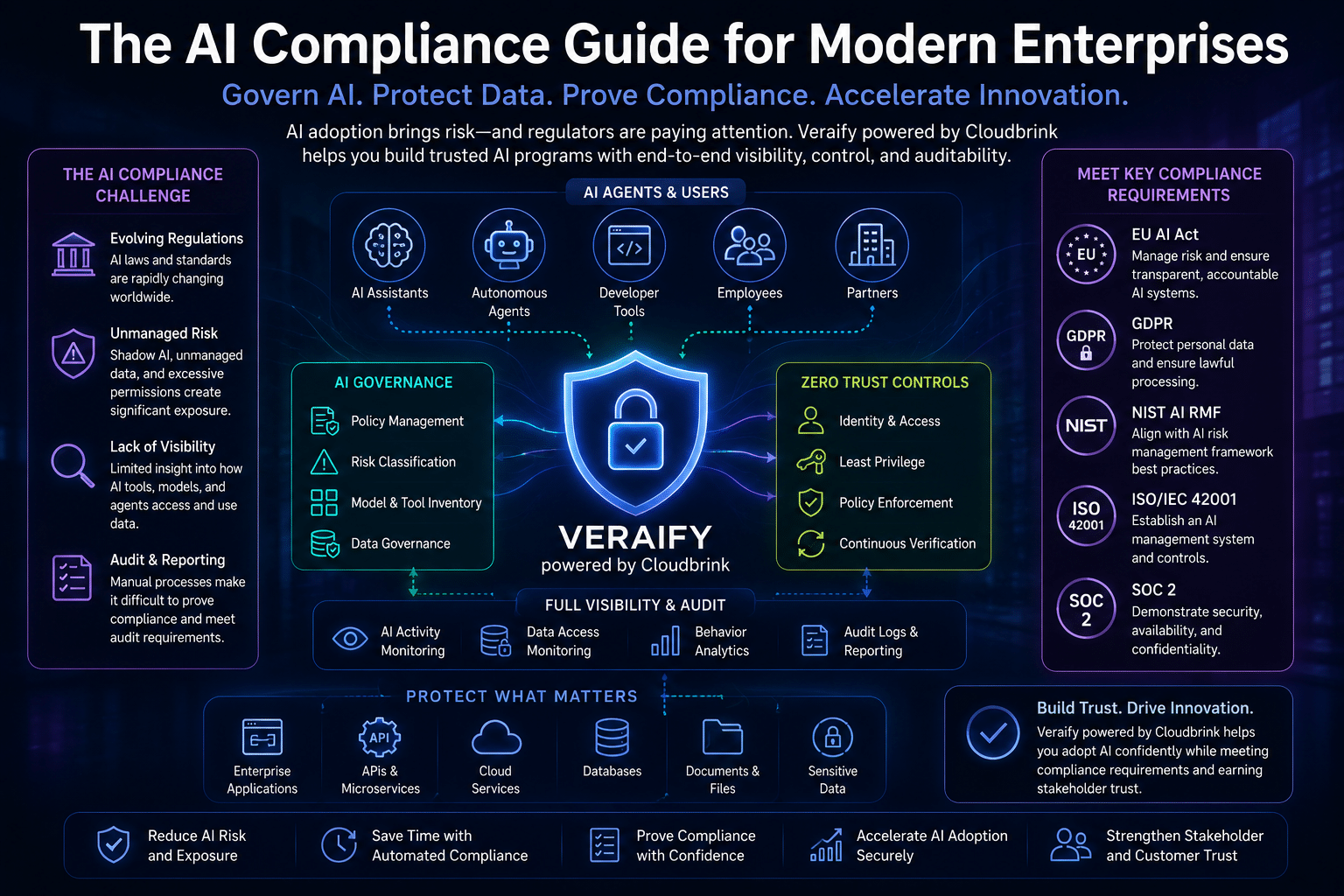
How Veraify Powered by Cloudbrink Supports AI Compliance
Veraify powered by Cloudbrink approaches compliance through a combination of:
- AI usage visibility
- AI-aware policy enforcement
- Sensitive data protection
- AI Runtime Security
- Zero-trust access controls
- Governance and audit capabilities
The platform is designed to help organizations understand how AI is being used, protect sensitive information before it leaves the organization, and apply governance controls across AI applications, AI agents, and AI workflows. Its AI Runtime Security and governance capabilities are intended to support organizations addressing compliance requirements while enabling AI adoption.
Ultimately, AI Compliance Explained reflects a commitment to ethical AI practices.
Key Takeaway
AI compliance is not about banning AI.
It is about ensuring that AI usage aligns with existing regulatory obligations and emerging AI governance requirements.
Whether the concern is GDPR, HIPAA, PCI DSS, or new AI-specific regulations, organizations need the same foundational capabilities:
-
- Visibility into AI usage
- Protection of sensitive data
- Governance and policy enforcement
- Auditability and accountability
- Continuous monitoring of AI interactions
AI Compliance Explained integrates with broader data protection frameworks for optimal results.
As AI becomes embedded in business operations, compliance programs must evolve from simply protecting data to governing how AI accesses, processes, and acts on that data.
Effective governance in organizations stems from understanding AI Compliance Explained.