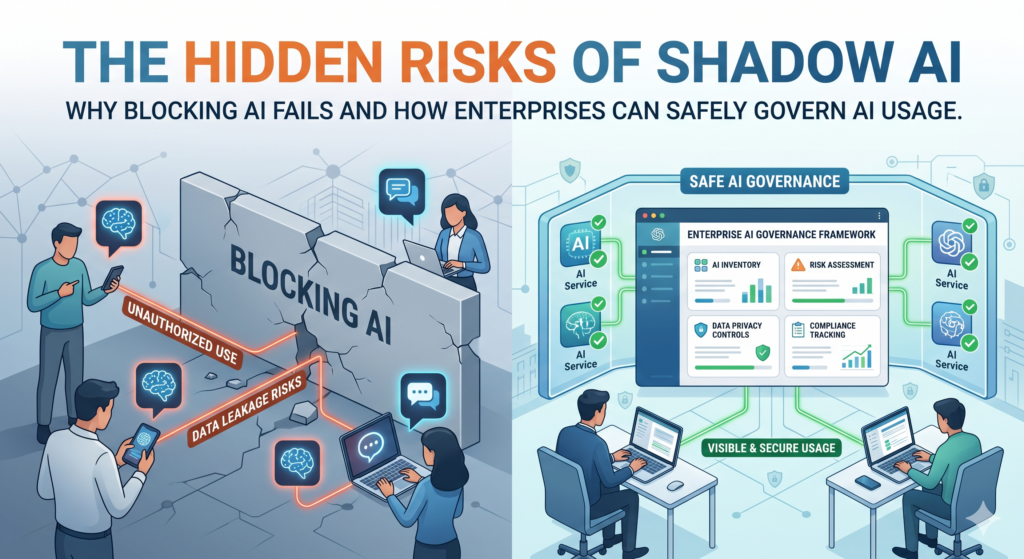
Shadow AI is the use of artificial intelligence tools, applications, agents, and services inside an organization without formal approval, visibility, or governance from IT and security teams.
It happens when employees use tools such as public AI chatbots, coding assistants, browser extensions, AI productivity tools, or autonomous agents to get work done faster — often without realizing they may be exposing sensitive company information.
Shadow AI is growing because AI works.
Employees are not adopting AI because they want to bypass security. They are adopting it because it helps them write faster, analyze information, automate tasks, create content, and solve problems.
The challenge for enterprises is no longer:
“How do we stop people from using AI?”
The real question is:
“How do we allow AI innovation while protecting our data?”
Blocking AI is not an AI governance strategy. It is a temporary reaction — and in many cases, it makes the problem worse, users find ways around it.
Why Shadow AI Has Become a Major Enterprise Security Risk
AI adoption has moved faster than traditional security models.
In previous technology shifts, IT often controlled the rollout. Applications were purchased, deployed, configured, and monitored centrally.
AI changed the rules.
Today, an employee can:
- Open a personal AI account
- Install an AI browser extension
- Add an AI coding assistant
- Run a local AI agent
- Upload documents for analysis
All within minutes.
Many of these tools operate outside traditional security visibility. Some interact with:
- Files
- Source code
- Customer information
- Intellectual property
- Internal documents
- Screens and browser content
- Business systems
This creates a new category of risk: AI activity that organizations cannot see, measure, or control.
Why Blocking AI Does Not Solve Shadow AI
Many organizations initially respond to shadow AI by blocking popular AI websites.
The logic seems simple:
“If employees cannot access unauthorized AI tools, the risk disappears.”
Unfortunately, that approach no longer works.
Modern AI usage extends far beyond websites. Employees increasingly use:
- AI-powered desktop applications
- AI assistants embedded into existing tools
- AI browser integrations
- Developer copilots
- Local AI agents
- Direct API connections
Blocking a list of websites only addresses part of the problem.
It can also create another issue: employees who need AI to stay productive may find alternative tools that are even harder for security teams to detect.
The result?
- Less visibility
- More shadow AI
- Greater risk
The New AI Governance Challenge: You Cannot Protect What You Cannot See
Effective AI governance starts with visibility.
Security teams need answers to basic questions:
- Who is using AI?
- Which AI tools are being accessed?
- What data is being shared?
- Are sensitive files being uploaded?
- Are employees using approved or unapproved AI services?
- Are AI agents accessing enterprise resources?
Without this visibility, organizations are forced into two bad options:
- Allow uncontrolled AI adoption
- Block AI completely and reduce innovation
Modern enterprises need a third option:
Enable AI safely.
What Should an Enterprise AI Governance Strategy Include?
A strong AI governance strategy should combine adoption with protection.
The goal is not to eliminate AI usage.
The goal is to create trusted AI usage.
A modern approach should provide:
- Visibility
- Protection
- Control
1. AI Usage Visibility
Organizations need a complete view of AI activity across users, applications, and locations.
This includes:
- Approved AI tools
- Unsanctioned AI applications
- Emerging AI services
- User activity patterns
Visibility turns unknown risk into manageable risk.
2. Sensitive Data Protection Before Information Leaves
Traditional security tools were designed for a world where humans accessed applications.
AI creates a different model.
Users and AI agents now exchange large amounts of information continuously.
Organizations need controls that help prevent sensitive data exposure before information is shared with AI services.
Examples include:
- Customer records
- Confidential documents
- Source code
- Credentials
- Regulated information
- Intellectual property
3. Intelligent AI Access Controls
Not every AI tool represents the same level of risk.
A developer using an approved coding assistant is different from an employee uploading confidential documents into an unknown AI website.
Effective AI governance requires context:
- Who is the user?
- What AI tool are they using?
- What information is involved?
- What action are they attempting?
Security policies should adapt based on risk — not simply block everything.
How Veraify powered by Cloudbrink Helps Organizations Control Shadow AI
Veraify powered by Cloudbrink helps enterprises move from AI restriction to AI governance and AI productivity.
Instead of forcing organizations to choose between productivity and security, Veraify provides the visibility and control needed to confidently adopt AI.
With Veraify, organizations can:
- Discover AI usage across the enterprise
- Identify unsanctioned AI activity
- Understand which users and tools create risk
- Apply AI-aware security policies
- Help prevent sensitive data exposure
- Secure access between users, AI tools, applications, and data
The result is simple:
Employees keep the productivity benefits of AI.
Security teams regain control.
Shadow AI Is Not the Enemy. Invisible AI Is.
AI adoption will continue accelerating.
The organizations that succeed will not be the ones that block every new AI tool.
They will be the ones that build the right governance foundation.
Because the biggest AI risk is not that employees are using AI.
The biggest risk is that they are using AI and you do not know about it.
Visibility comes first.
Governance follows.
Innovation continues.
Ready to See Your Shadow AI Risk?
You cannot secure AI you cannot see.
Take the first step toward safe AI adoption.
Test drive Veraify powered by Cloudbrink and discover how your organization can gain AI visibility, control unsanctioned AI usage, and build a secure foundation for enterprise AI governance.
Experience AI without the blind spots. Test drive Veraify today.